


Comparative life cycle assessment “Terrace structures with different surface layers”

In the construction industry, climate protection and resource consumption are becoming increasingly important issues in the sustainability debate. The environmental impact of building materials and construction methods, e.g., the associated CO2 emissions and energy consumption, are therefore becoming a greater focus in the planning of construction projects.
The Betonverband SLG published the first comparative life cycle assessment of superstructure constructions using the example of an access road at the beginning of 2009. This was followed by publications of life cycle assessment data on superstructure constructions for selected typical areas of application in qualified road construction, such as a residential collector road or a pedestrian zone, in 2015, as well as the current study from March 2025 [1]. In the latest study from July 2025, these were supplemented by life cycle assessment values determined in accordance with the relevant standards for standardized terrace structures with surface layers made of various mineral coverings as well as wood and wood composite materials, using a frequently occurring example from the field of gardening and landscaping.
The comparative life cycle assessment study “Terrassenaufbauten mit unterschiedlichen Deckschichten” [2] highlights in particular the environmental impact in terms of greenhouse potential (CO2 emissions, GWP) and the use of non-renewable primary energy (PERNT). The indicators mentioned allow conclusions to be drawn with regard to climate change and energy and resource efficiency, which are of great political interest and are among the most pressing environmental issues of our time.
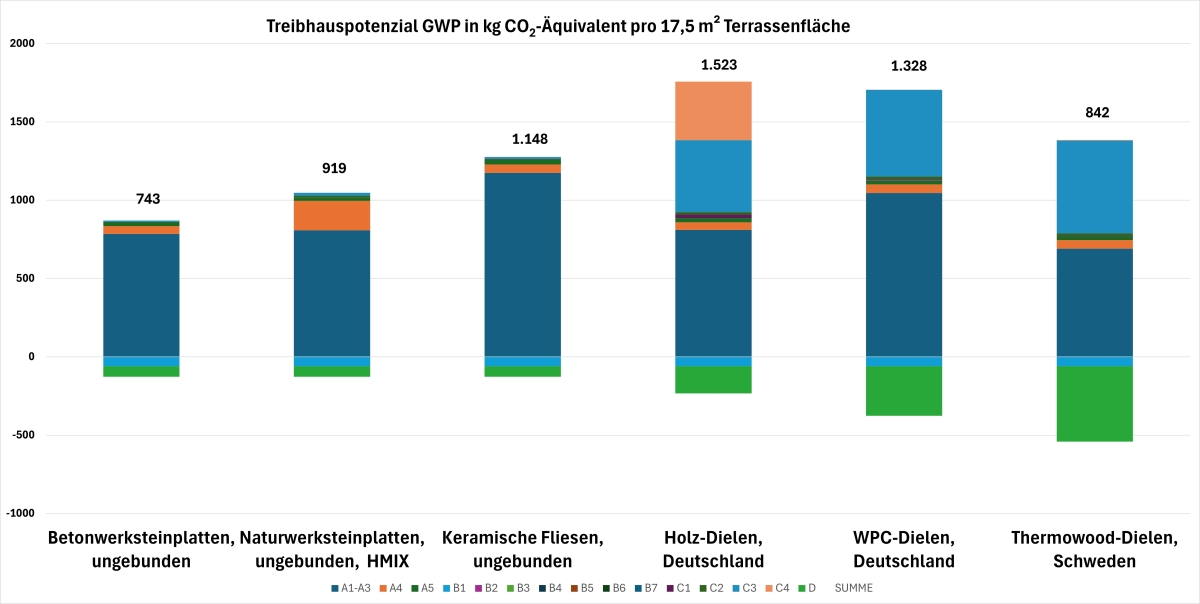
When looking at the results of the life cycle modules (see
Fig. 1), it is striking that terrace constructions using concrete slabs in an unbound design can easily compensate for the costs incurred in the manufacturing phase due to their excellent reusability in the end-of-life scenario. In summary, when considering the cradle-to-grave approach, the concrete block variants within the compared terrace structures show the most favorable results in terms of GWP and PERNT.