
Modernization of mixing technology at Ehl in Roßla: New Haarup mixers for higher capacity and flexible production processes
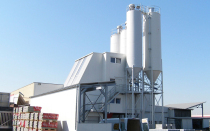
Ehl AG has replaced two existing systems with new Haarup mixers at its Roßla site in the Southern Harz region. The goal of the modernization was to achieve higher production capacity and greater flexibility in production. The implementation took place during ongoing operations and required extensive modifications to the existing mixer platform. During an on-site visit by BFT International, representatives from Ehl and Haarup provided information on the planning, installation, and commissioning of the new mixing technology.
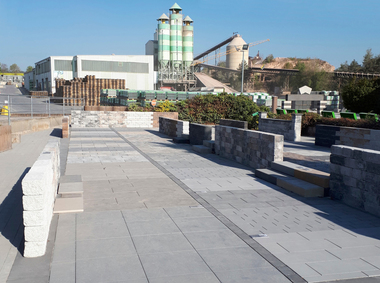
Ehl AG, headquartered in Kruft, is part of the CRH Group and operates more than 20 production sites in Germany. The company produces, among other things, paving stones, patio slabs, wall and retaining wall systems, as well as other concrete products for gardening and landscaping. In recent years, Ehl has increasingly invested in sustainability, energy efficiency, and the modernization of existing production sites. Haarup has also set similar priorities: In recent years, the company has made significant investments in the sustainable transformation of its own production processes and has established corresponding climate protection measures as part of the Science Based Targets Initiative (SBTi).
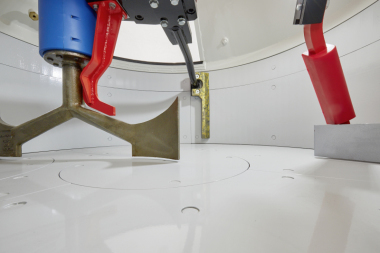
At the Roßla site, Ehl decided to replace two existing mixers and fundamentally modernize the mixing technology. Today, two identical Haarup mixers with a 1,500-liter capacity are in use. Ehl deliberately chose two identical mixers. According to the company, this increased capacity by 33% while simultaneously simplifying spare parts management.
According to Ehl, the existing mixing technology had previously reached its limits in terms of production capacity. “We saw where the bottleneck was—and that was the mixer,” explained Ute Haberle, Regional Technical Manager for the South Harz region at Ehl AG.
Higher Capacity and New Production Requirements
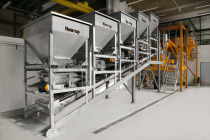
The modernization was not limited to simply replacing the mixers. Rather, the existing infrastructure had to be extensively adapted. This included, among other things, the physical separation of the dosing systems so that other production areas could continue to operate during the renovation work.
“We first had to physically separate the dosing systems,” Haberle explained. “In doing so, the conveyors and dosing systems were separated from one another in such a way that the remaining equipment could continue to run without being affected.”
At the same time, the existing mixer platform was rebuilt and adapted to the new technology. Some of the existing components could be reused. For Ehl, it was important to continue using as much of the existing equipment as possible.
To maintain production during the renovation phase, Ehl temporarily worked with ready-mix concrete.
3D Planning and Renovation of the Existing Plant
Digital planning of the conversion played a central role. Haarup used 3D laser scans of the existing steel structure for this purpose. “We use our 3D laser scanning equipment to survey the entire existing plant,” explained Christian Søndergaard, Area Sales Manager at Haarup, during the plant visit. The data obtained formed the basis for integrating the new mixers into the existing structure.
“We were already familiar with Haarup in the market,” Haberle explained. “The 3D scanner technology allowed us to immediately recognize their professionalism.”
Integrating the larger mixers into the existing plant presented the project team with several challenges. With the switch to a different mixer type, adjustments to the existing platform were particularly necessary, explained Søndergaard.
Despite the larger mixers, the available working space on the platform was improved, according to Ehl. “We now have more space and greater freedom of movement,” said Haberle. The admixture technology and other components were also repositioned.
In addition, production logistics had to be adjusted. One of the new mixers was equipped with two discharge outlets. At the same time, the spatial conditions placed high requirements on the installation. “We couldn’t lift the mixer directly from the front, but had to work practically through a keyhole,” Haberle described the situation.
The actual installation of the new mixers began in early January. According to those involved in the project, the units were hoisted into place within a few hours. “The crane arrived at eight in the morning, and the job was already finished by noon,” reported Haberle.
New Haarup Mixing Technology
Haarup specializes in the modernization of existing concrete plants and has already completed projects in numerous international markets—from Scandinavia to Australia and New Zealand. The Danish family-owned company develops and manufactures its equipment at its Silkeborg facility.
The mixer’s gear technology plays a special role in this. According to the company, Haarup manufactures the gearboxes in-house and highlights their particularly robust and proven design. The company claims to be the only supplier in the market to offer an eight-year warranty on the gearboxes.
As part of the project in Roßla, Haarup supplied, in addition to the two 1,500-liter mixers, new cement scales, dosing screws, extraction filters, elevators, and a new service platform, among other items.
Several additional detailed adjustments were made during the project phase. For example, Ehl decided at the last minute to add additional lining to individual elevator components to reduce wear.
The project also held strategic significance for Haarup. “It was extremely important for Haarup that we make a strong impression here at Ehl in Germany,” explained Søndergaard. Haarup already had a strong presence within the CRH Group in Scandinavia, Benelux, and North America, but despite having sold more than 300 mixers in Germany, these are the first mixers supplied to Ehl.
Supplementary dosing technology
The plant was additionally equipped with an MD400 FS/FR fiber dosing system from Würschum GmbH. The system is designed for dosing micro- and macro-fibers as well as various steel fibers.
Training and Maintenance Concept
After installation was completed, employees received additional training in the maintenance and servicing of the new mixing technology. The focus was on lubrication, maintenance intervals, and spare parts management, among other topics.
Søndergaard emphasized the importance of collaborative project work: “Once the contract is signed, you’re on the same side of the desk and have to solve the task together.”
Teamwork as a Success Factor
The collaboration between Ehl and Haarup is described by both parties as a key success factor. “It was a collaborative effort across the entire construction site over several weeks,” said Haberle. In addition to the collaboration with Haarup, she particularly highlighted the work with her colleagues Sascha Karnstedt and Christopher Rüdig.
By the end of the project, the focus for everyone involved was primarily on the joint implementation. “It wasn’t a given that things would go as smoothly as they did,” Haberle summarized.
According to EHL, the first results of the modernization are now becoming apparent. “We are already seeing the added value of the new plant,” Haberle explained. “Production capacity has been increased.”
At the same time, product quality has remained at the previous level. Furthermore, the new mixing technology opens up additional possibilities for future production requirements. These include, among other things, the processing of SV concrete as well as more flexible testing of new admixtures and formulations.
Now that this modernization project has been completed, EHL and Haarup are looking forward to new projects together.
CONTACT
Haarup Maskinfabrik A/S
Haarupvej 20
8600 Silkeborg/Denmark
+45 86 84 62 55
EHL AG
Standort Roßla
Güterbahnhof 6
06536 Südharz/Germany
+49 3 46 51 / 3 71 0