


Stormwater Management for Heavy-Duty Traffic Areas
06.07.2026
 Figure: Hauraton
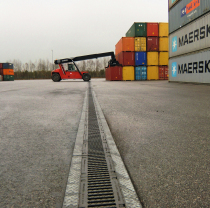
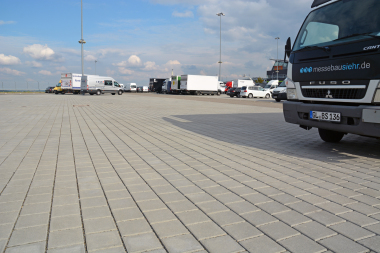
Heavy-duty traffic areas, such as airports, logistics facilities, and industrial sites, place high demands on stormwater management. In addition to efficient heavy-duty drainage, the treatment, retention, and near-natural infiltration of stormwater are becoming increasingly important. Hauraton develops system solutions that combine hydraulic performance, durability, and sustainable water management.
Figure: Hauraton
Heavy-duty traffic areas, such as airports, logistics facilities, and industrial sites, place high demands on stormwater management. In addition to efficient heavy-duty drainage, the treatment, retention, and near-natural infiltration of stormwater are becoming increasingly important. Hauraton develops system solutions that combine hydraulic performance, durability, and sustainable water management.
Challenges in Heavy-Duty Drainage
Every application area in the heavy-duty sector—airports, industrial and logistics sites, as well as ports and container terminals—presents specific challenges for planners.
What do all heavy-duty areas have in common?
The safe movement of large and heavy vehicles, such as reach stackers or aircraft, must be ensured. This involves specific, real-world loads caused by the dynamic passage of heavy-duty vehicles. At the same time, climate change is causing increasingly frequent heavy rainfall events. High-performance heavy-duty drainage therefore plays a central role in holistic stormwater management. What is crucial is not merely the rapid drainage of water, but a coordinated interplay of collection, conveyance, treatment, retention, and infiltration. This supports the natural water cycle.
Standards and Regulations
Drainage channels are subject to the European Standard EN 1433. For areas subject to particularly high wheel loads, heavy-duty channels of load class E 600 or F 900 are required. If an airport is to be drained, additional load-bearing capacity and serviceability verifications must be taken into account.
When environmental requirements call not only for the drainage of heavy-duty traffic areas but also for the treatment of stormwater, stormwater treatment is essential. Separate regulations exist for this purpose, which also provide recommendations for the use of infiltration and retention solutions.
The load-bearing capacity of infiltration and retention elements is often specified in SLW (heavy-duty truck). For example, SLW 30 stands for the corresponding total load of a 30-metric-ton truck. This classification originates from a historical standard (DIN 1072), which was replaced by EUROCODE 1 DIN EN 1991-2. Although this standard no longer includes a classification based on SLW, this specification remains widely used.
Consequences of Improper Rainwater Management for Heavy-Duty Traffic Areas
If the rainwater management solution for a heavy-duty traffic area is not designed to meet the technical challenges and standards, this can lead to serious consequences:
Material damage or deformation due to incorrect load classes and materials
Risk of injury from loose structural components
Disruption of drainage due to recurring repair work
Environmental damage, such as contamination of groundwater, surface water, or municipal sewer systems
What must rainwater management solutions for heavy-duty applications be able to do?
Resistance to extreme loads and dynamic forces:
The materials and design of the systems should be robust enough to withstand the high frequency and various forces caused by the braking, acceleration, and rotational movements of vehicles.
High hydraulic capacity:
Drainage systems on large impervious surfaces must be able to quickly absorb particularly large volumes of water, reliably store it temporarily, and direct it to the appropriate destinations, especially in light of increasing heavy rainfall events.
Reliable purification performance:
Surface runoff from heavy-duty areas is contaminated with microplastics, tire abrasion, and oil residues. If rainwater is to be allowed to infiltrate on-site or used for other purposes, these contaminants must be reliably filtered out and retained.
Large retention volume:
In order to use rainwater after treatment or allow it to infiltrate, a sufficiently large retention capacity is necessary to safely store the water temporarily.
CONTACT
Hauraton GmbH & Co. KG
Werkstr. 13
76437 Rastatt/Germany
+49 7222 958-0