

Jonkers

Dutch microbiologist develops self-healing bio-concrete
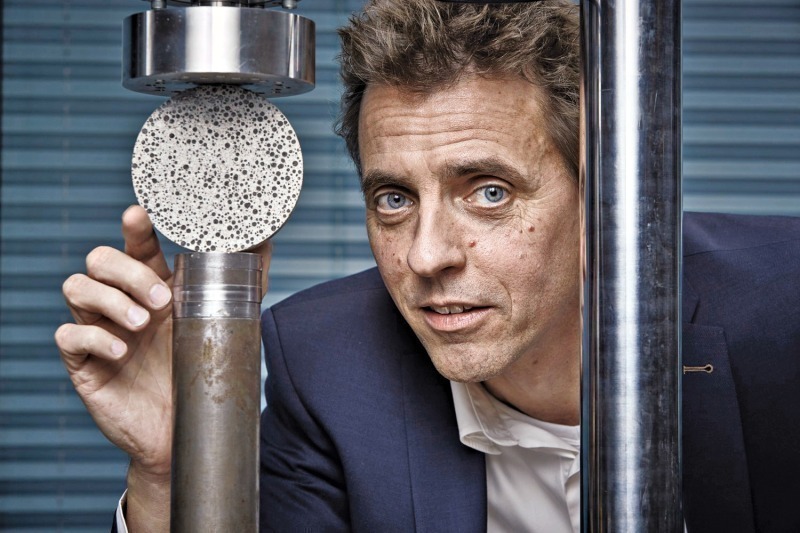
Concrete buildings and other structures that are able to close and self-heal stress-induced cracks are no longer utopia but can soon become reality, thanks to an invention by the Dutch microbiologist Hendrik Marius Jonkers. His vision consisted of increasing the tensile strength and enhancing the environmental soundness of concrete with the aid of nature, reducing in this way both the costs of concrete production and maintenance, and of containing the resulting CO2 emission. Towards this objective, Jonkers developed a bio-concrete with bacteria that can survive up to 200 years in a concrete...

Related articles:

Issue 03/2026

Bacteria for Self-Healing Concrete – Project Examples and Current Results

Evonik’s Sitren Selfheal 455 is an innovative powder formulation based on natural microbes, nutrients, and surface-active ingredients designed to enhance the longevity and sustainability of concrete...

more
Issue 02/2014 Development and testing

Concrete with properties to repair itself –

The development of cementitious materials exhibiting properties to heal or seal, respectively, cracks is an actual topic, while autogenous healing mechanisms – in regard to fractures with water...

more
Issue 01/2019 DOLOMITE MICROFLUIDS

Cambridge researchers developing self-healing concrete

Researchers at the University of Cambridge (Department of Engineering’s Geotechnical and Environmental Research Group) are using microencapsulation technologies developed by Dolomite Microfluidics to...

more
Issue 05/2025

A device of cell/units for making biomineralized concrete products useful for hydrogen generation, transportation, and storage

(10) WO2025019070A1 (22) 23.05.2024 (43) 23.01.2025 (57) One of the key net-zero challenges is hydrogen transportation with a viable infrastructure delivering it from where it is produced to the point...

more