


A New Approach to Building Components: From Residential to Industrial Construction – Insights from Garching and MLP Berlin Spreenhagen
 Figure: Suppgrade
 Figure: Suppgrade
 Figure: Suppgrade
 Figure: Suppgrade
 Figure: Suppgrade
 Figure: Suppgrade
 Figure: Suppgrade
 Figure: Suppgrade
Built-in components are an integral part of construction planning and, in practice, are already provided with the plan. The challenge, however, lies in the fact that they have not yet followed a uniform system of parameters and standard-based attributes. This results in inconsistent data structures, which significantly complicate consistent evaluation and comparability. Two projects in residential and industrial construction demonstrate the role that systematic integration plays in planning and execution.
Over 20,000 built-in components in a single model—and yet a consistent process: What initially appears to be a theoretical possibility has already been implemented in practice, for example in the industrial construction project of the MLP Group S.A., a developer, owner, and manager of high-quality commercial, industrial, and logistics parks specializing in brownfield sites, in Spreenhagen, Brandenburg. By comparison: Even larger residential construction projects, such as the development in Garching, with around 7,000 building components, are already on a scale considered challenging from a planning perspective. Two projects, two benchmarks—and one key insight: Building components are not a detail, but an independent system within the digital building model.
Built-in components in the BIM process – an underestimated challenge
In practice, the challenge lies less in the geometric representation of the components and more in their consistent integration into the planning process. Components are often created outside the actual BIM model—for example, in the form of external libraries, manufacturer-specific data sets, or manually added information. This results in inconsistent data structures, a lack of continuity, and increased coordination efforts between planning, shop preparation, and execution. It is precisely at this interface that it is determined whether a digital model serves merely for visualization or functions as a reliable foundation for the construction process.
Reference Project: Garching (Residential Construction)
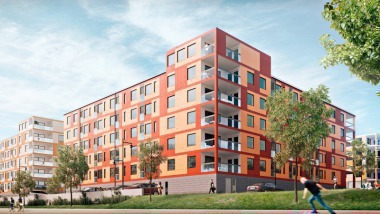
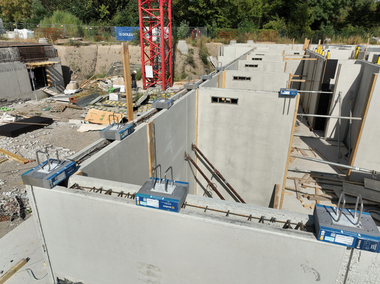
In the residential construction project in Garching with an underground garage (client: BHB Projektgesellschaft, BIM model: Muckingenieure innovative Tragwerksplanung GmbH), the relevance of structured planning is already clearly evident with approximately 7,000 components. Components from the Supparts system by Suppgrade were used.
The scale of the project illustrates its complexity:
over 5,000 dowel strips
around 250 shear force dowels
approximately 8 km of joint plates
What is decisive here is not just the number, but the combination of high quantities of individual component groups and, at the same time, a wide variety of variants. The model thus comprises more than 30 different types of built-in components, while individual groups each number several thousand units. This overlap of mass and diversity makes built-in components a standalone planning system within the overall model.
Reference Project: MLP Berlin Spreenhagen (Industrial Construction)
This trend is further amplified in the MLP Group S.A. industrial construction project in Spreenhagen. The approximately 39,000 m² multi-user park for users in the fields of production, logistics, and (online) retail was developed in collaboration with LIST—a provider that develops, plans, and builds real estate across a wide range of asset classes nationwide, from renovation of existing buildings to turnkey new construction, all under one roof—and, with over 20,000 built-in components, reaches a scale where conventional planning approaches reach their limits. The challenge arises less from the sheer volume than from the multitude of different types, variants, and project-specific custom solutions.
Under these conditions, a complete mapping of all built-in components via a single system is not always realistic. What is crucial, rather, is a consistent approach that brings together different sources. In MLP Berlin Spreenhagen, project-specific components can also be systematically recorded and analyzed together with Supparts. This makes it clear: It is not the origin of the data that matters, but its consistent integration within the model.
Implications for Practice
Both projects consistently demonstrate that progress lies less in the individual component and more in how the associated information is handled. Building components are evolving from subordinate details into integral parts of the digital building model. In practical implementation, this leads to fewer queries, clearer responsibilities, and greater overall process reliability.
From Component to Information Carrier
Parameterized building components such as Supparts link geometric properties with structured information for planning, evaluation, and ordering. This transforms building components into functional elements within the digital model that provide process-relevant data beyond their mere location in the structure.
From the model to execution
The added value is particularly evident throughout the entire process chain. In addition to geometric representation, the built-in components provide structured data that can be used in various project phases. This creates a direct link between planning, work preparation, and execution, with the model serving as the central information base. Built-in components thus evolve from a potential source of uncertainty into a stable component of the digital process.
Conclusion: From Detail to System
The residential construction project in Garching and the MLP Berlin Spreenhagen project demonstrate that the technological prerequisites for the seamless integration of built-in components are already in place. What is crucial is their consistent application in the planning and execution process. Built-in components are thus increasingly becoming a natural part of the digital building model.
Most of the available Supparts can currently be used at no additional cost. According to the provider, approximately 95% of the elements are available directly within the Allplan environment; further integrations with other systems have been announced. Available at:www.suppgra.de
Built-in components thus become a natural part of the digital building.