


3D concrete printing of buildings – experiences with mobile boom systems and thick-layer processes


3D concrete printing of buildings is a forward-looking technology for addressing the personnel, ecological, and economic challenges of the construction industry. The construction sector is responsible for around 40% of global energy consumption; at the same time, optimized use of materials and efficient construction processes offer potential savings of 30-70%. 3D concrete printing makes an important contribution here, as it enables a high degree of automation, reduced manual labor, and resource-saving construction methods. At the same time, this counteracts the acute shortage of skilled workers in the construction sector.
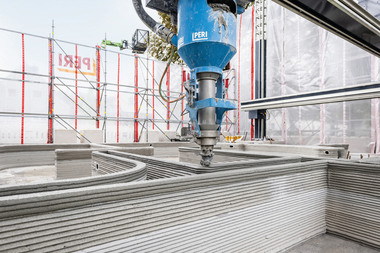
The Instatiq P1 system is based on an extrusion-based process in which a continuous strand of concrete is applied layer by layer. Unlike traditional gantry printers, the P1 has a mobile boom mounted on a large-capacity manipulator, which allows for a high degree of flexibility and mobility on the construction site. The printer processes concrete in accordance with DIN EN 206 with a maximum grain size of up to 8 mm. The digital printing process is controlled on the basis of a 3D model, which is first translated into individual layers (“slicing”) and then into G-code to determine the printing paths, speeds, and layer sequences. By flexibly adapting the wall thicknesses to the static requirements, material is only used where it is structurally necessary, which can significantly reduce the greenhouse potential of the building.
A clear example of the use of the Instatiq P1 is a residential building in Metzingen, which was realized in cooperation with Strabag/Züblin. On a floor area of approximately 180 m², the load-bearing components were printed directly on the construction site at a building height of up to 12 m, with the printing process being precisely monitored. The use of the mobile boom eliminated the need for conventional and time-consuming bricklaying. The planning and approval procedures were carried out in close coordination with the responsible authorities and were scientifically supported by KIT/MPA Karlsruhe. The project demonstrates that 3D concrete printing with the Instatiq P1 not only enables resource-saving construction, but also represents an efficient and flexible alternative to traditional construction methods.