


New “energy foundation” for the installation of energy and climate control systems
07.04.2026
 Figure: Christoph Betonwaren
Modern energy and HVAC technology consists of high-quality systems designed to operate reliably, quietly, and efficiently for many years. These systems must be installed in a stable and wind-resistant manner. For ground-mounted units, however, constructing the necessary foundations often proves to be time-consuming and costly. A new solution from Christoph Betonwaren (Freudenberg) offers a remedy: the “Energy Foundation” made of high-quality reinforced concrete. Weighing just 42 kilograms and measuring one meter in length, it can be installed quickly and easily and is designed for long-term outdoor use. The special feature: Thanks to an integrated, hot-dip galvanized mounting rail, technical equipment can be securely connected to the foundation blocks without any drilling.
Figure: Christoph Betonwaren
Modern energy and HVAC technology consists of high-quality systems designed to operate reliably, quietly, and efficiently for many years. These systems must be installed in a stable and wind-resistant manner. For ground-mounted units, however, constructing the necessary foundations often proves to be time-consuming and costly. A new solution from Christoph Betonwaren (Freudenberg) offers a remedy: the “Energy Foundation” made of high-quality reinforced concrete. Weighing just 42 kilograms and measuring one meter in length, it can be installed quickly and easily and is designed for long-term outdoor use. The special feature: Thanks to an integrated, hot-dip galvanized mounting rail, technical equipment can be securely connected to the foundation blocks without any drilling.
Air-source heat pumps, photovoltaic modules, outdoor air conditioning units: Anyone building or renovating today cannot do without these key components of modern energy supply. However, this technology must be installed securely. To make installation as quick and cost-effective as possible, there is now a particularly well-designed solution: the “Energy Foundation” from Christoph Betonwaren (Freudenberg). It is made of reinforced concrete that is both sturdy and durable, and allows professionals and DIYers to complete installation in just one day. This is made possible by a mounting rail already firmly integrated into the foundation blocks, so that the technical equipment only needs to be screwed into place—no drilling required. The “Energy Foundation” is equally suitable for new construction, retrofitting existing buildings, or modernizing existing systems.
Frost-free foundation recommended
“Good planning is also important for the ‘Energy Foundation.’ Choosing the right location is crucial: For example, with an air-source heat pump, the appropriate spacing from buildings and other large objects must be maintained to ensure sufficient air circulation,” explains Torsten Wilfert, Managing Director of Christoph Betonwaren. A solid and load-bearing subsoil is equally important. For the installation of the “Energy Foundation,” the manufacturer therefore recommends a frost-free foundation. Accordingly, the pit should first be excavated to a depth of 80 centimeters. The pit size depends on the footprint of the equipment to be installed: an additional allowance of about ten centimeters all around is the guideline here. Next, frost protection material with a grain size of 0/32 or 0/45 millimeters is installed in three layers, each 20 centimeters thick, and compacted layer by layer using a tamper or a vibrating plate. Afterward, the two solid foundation blocks are laid flush and level on two strips of earth-moist screed concrete, each 15 centimeters wide and five centimeters high.
Accessories for every need
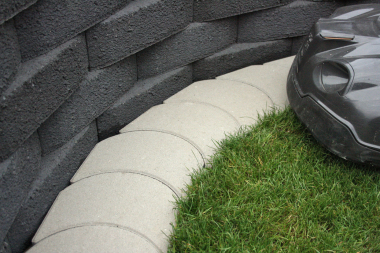
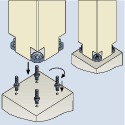
To minimize splash water or dirt, the “Energy Foundation” should be installed so that it sits approximately five to ten centimeters above ground level. Alternatively, however, it is possible to create even more height using a special base stone. This can be useful—especially for air-source heat pumps—for reasons such as flood protection. At the same time, raising the technical equipment facilitates access for maintenance and service work. With the optionally available mounting accessories, equipment and systems can be quickly and securely mounted on the Energy Foundation. The vibration dampers included in the mounting accessories serve to decouple vibrations between the system and the foundation. This reduces structure-borne noise, ensuring quiet operation with maximum smoothness. “Combined with other innovative products from our company—such as the cable and hose duct and the trapezoidal mowing stone—the necessary cables for modern energy technology can also be laid permanently, securely, and protected,” adds Torsten Wilfert.
CONTACT
Christoph & Co. GmbH
Heisberger Straße 211
57258 Freudenberg
+49 2734 - 27 58 0