

European construction equipment sector sees moderate recovery in 2025 with 4.6% growth in sales
02.03.2026
 Figure: CECE
The European construction equipment industry stands at a decisive moment. The CECE Annual Economic Report 2026 shows that after reaching a low point in 2025, the market is stabilising and moderate growth prospects are emerging – provided that the right economic and political framework conditions are put in place now.
Figure: CECE
The European construction equipment industry stands at a decisive moment. The CECE Annual Economic Report 2026 shows that after reaching a low point in 2025, the market is stabilising and moderate growth prospects are emerging – provided that the right economic and political framework conditions are put in place now.
Performance 2025
At the macroeconomic level, conditions remain challenging. European economic growth is weak, with GDP increasing by around 0.9% in 2025, while investment remains constrained and consumption grows only modestly. Although interest rates have stopped rising and are gradually stabilising, they remain high compared with pre‑2022 levels, continuing to weigh on household finances and real estate investment. Within this environment, the European construction sector remains uneven.
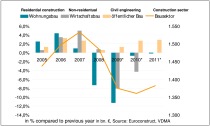
But, in 2025, the European construction equipment market could stop its downturn and even saw moderate sales growth of 4.6% compared to the previous year. Residential building continues to be the main area of weakness, reflecting the ongoing housing downturn across most major European markets. Overall construction output is broadly stable year on year, however, as growth of around 3% in civil engineering and infrastructure activity offsets the decline in building. Infrastructure investment therefore continues to play a stabilising and cushioning role for the sector. Overall, 2025 marks a transition year for the European construction sector with growth drivers remaining fragile.
Outlook 2026
The outlook for 2026 is more positive. Stabilising interest rates, a gradual recovery in private investment and the continuation of infrastructure programmes are expected to support a return to moderate growth of around 2% to 2.5%. This improvement should be driven by a recovery in housing after two years of steep decline, alongside increased investment linked to the energy transition and infrastructure development. The sector enters 2026 with the prospect of a gradual recovery, largely dependent on macroeconomic conditions and public investment policies rather than a spontaneous rebound in demand. The industry continues to face structural challenges, including overregulation and unfair competition as well as the unpredictability of the important US market. Addressing these challenges will require close cooperation between industry and policymakers at both European and national level.
CONTACT
CECE - Committee for European Construction Equipment
Rue Jacques de Lalaing 4
1040 Brussels/Belgium
+32 2 706 82 26