
Promotion of resource-saving and climate-friendly concrete in Baden-Wuerttemberg

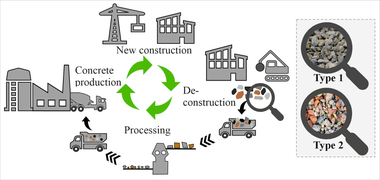
In recent years, the production of concrete with recycled aggregates (RAC) has established itself as a promising option to reduce the consumption of primary resources in the production of concrete. Nevertheless, processed construction and demolition wastes are rarely used as aggregates in concrete [1]. There are various reasons. In addition to the recycling paths that are easier to implement from a technological and regulatory point of view, the varying regional degrees of availability and higher expenditures are impediments on the part of the concrete producers. To change this, the Baden-Wuerttemberg Ministry of the Environment has provided a funding scheme by means of the “administrative provision on resource-saving and climate-friendly concrete in building construction (VwV R-Beton)” in 2023, aiming at increasing the use of concrete with recycled aggregates in the south-west region. Apart from financial subsidies for extended initial testing that is required for the first production of concrete using recycled aggregates, subsidies are granted for part of the purchase costs of recycled or wet-classified aggregates. The funding scheme was prolonged in 2025, with adjusting the funding rates. The use of low-clinker cement was also stipulated as an applicable amendment. In addition to the manufacturers of ready-mixed concrete, the producers of precast concrete elements can get subsidies now as well.

The first phase of the funding program was scientifically monitored by KIT-IMB/MPA/CMM. In this regard, the manufacturers of ready-mixed concrete were supported in extended initial testing. Furthermore, sampling and analysis of the used aggregates were conducted.

References/Literatur
[1] Ministerium für Umwelt, Klima und Energiewirtschaft Baden-Württemberg (Hg.): Abfallbilanz 2024, Stuttgart (2025) URL: https://um.baden-wuerttemberg.de/fileadmin/redaktion/m-um/intern/Dateien/Dokumente/2_Presse_und_Service/Publikationen/Umwelt/Abfallbilanz-2024.pdf
x

Related articles:

Issue 03/2025

Extension of the design rules for RAC for resource-efficient construction of the future

In view of the elevated level of carbon emissions and scarcity of natural resources, new concrete mix designs are constantly being tested to meet the increased requirements for resource-efficient and...

more
Issue 11/2017

R concrete for concrete products and precast concrete elements

R concrete with a proportion of recycled aggregates made from crushed concrete and crushed masonry in compliance with standards are standardized normal concretes which are allowed for use in Germany...

more
Issue 02/2016 Sensor-based sorting

Recycled concrete production

Problem The Act on Recycling and Waste Management (Kreislauf-wirtschaftsgesetz) intends for secondary raw materials, such as recycled aggregates produced from mineral construction and demolition...

more
Issue 03/2025

Cement recycling – Sustainability at the interface between climate and resource protection

The production of concrete or its primary component cement, is associated with substantial carbon emissions and high consumption of resources. To reduce these impacts, various solutions have been...

more
Issue 03/2025

Concrete with 100% recycled mineral aggregates – A precast production case study

Adding recycled mineral aggregates to concrete mixes commonly used in building construction appears to be a promising approach to conserving natural resources. This paper focuses on the bond behavior...

more