


Optimized design of punching shear reinforcement according to the new Eurocode 2


The further development of design concepts for reinforced concrete structures, in particular the punching shear design of flat slabs and footings, represents a key challenge in structural concrete. The current Eurocode only considers stirrups as punching shear reinforcement. The load-bearing capacity is determined additively from a reduced constant concrete contribution and a steel contribution that depends on the anchoring behavior. This leads to a systematic underestimation of the load-bearing capacity, especially in the case of low to medium punching shear reinforcement ratios. In the new version of Eurocode 2, the verification methods for flat slabs and footings have therefore been unified, and double-headed anchors and practical punching shear reinforcement variants have been included for the first time. In addition, the additive approach has been improved by continuously varying concrete and steel contributions. Tests with low and medium reinforcement ratios are necessary for the systematic investigation of these components.
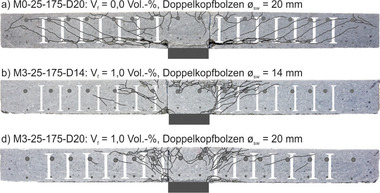
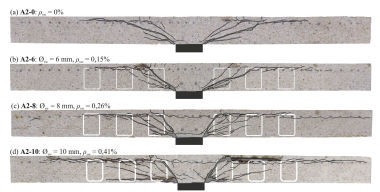
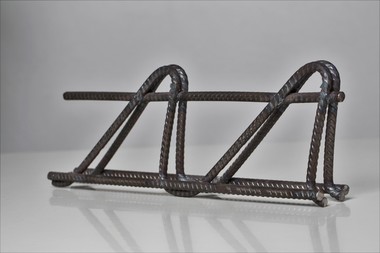
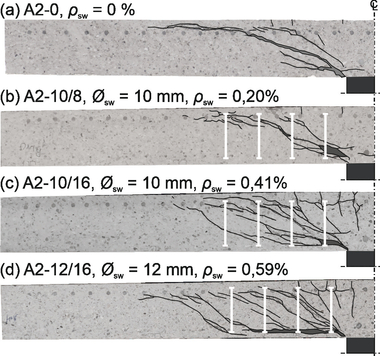
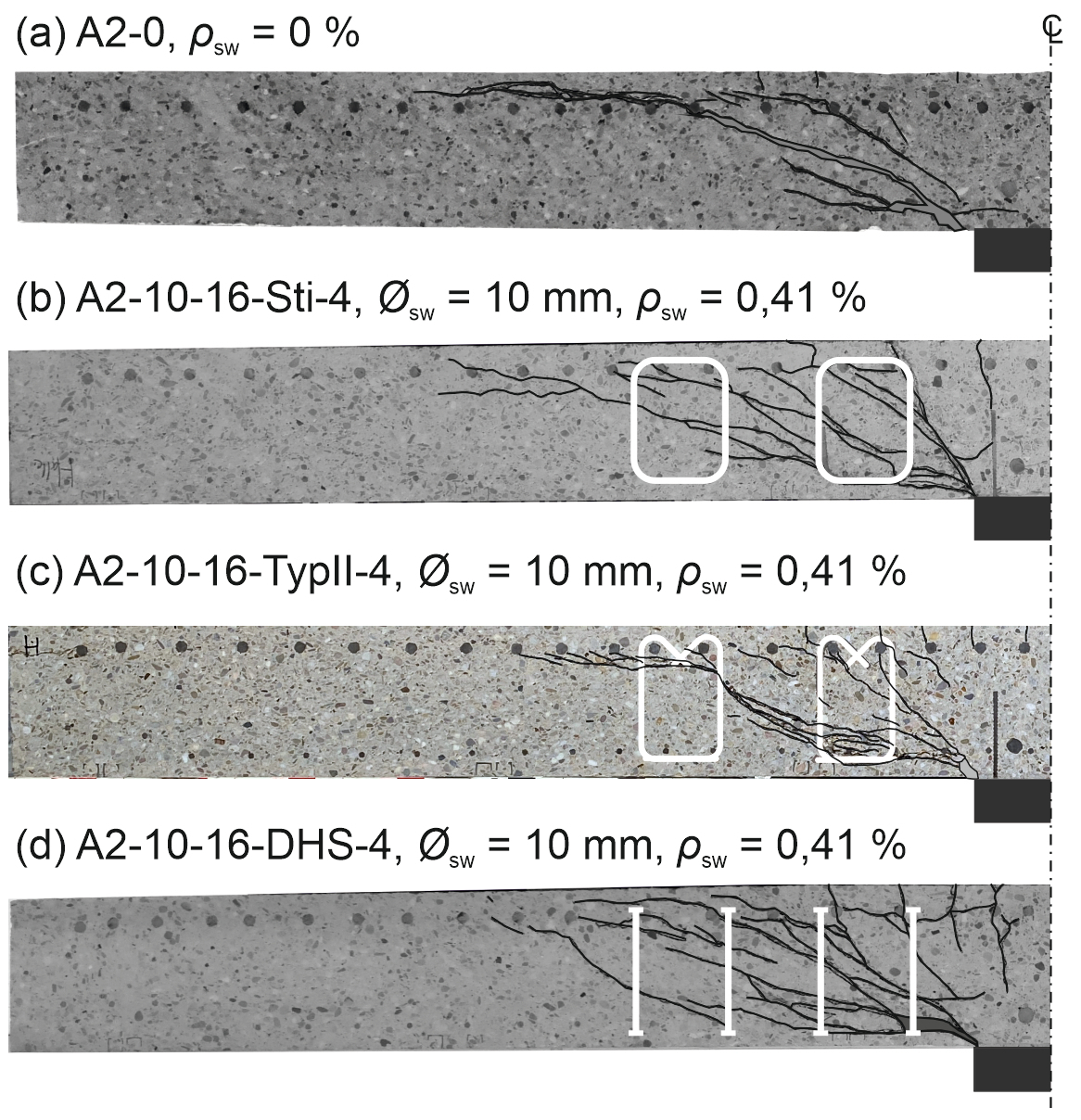
In the research project presented, a total of 14 isolated flat slabs with varying degrees of punching shear reinforcement were investigated. Practical reinforcement solutions such as double-headed studs (Fig. 1(d)) and shear connectors (Fig. 1(c)) were used. The test design allowed a detailed analysis of the transition from punching shear failure without reinforcement (Fig. 1(a)) to failure at maximum load-bearing capacity. The results show that the steel contribution reaches a high activation level almost independently of the degree of reinforcement. The concrete contribution, on the other hand, is highly dependent on the degree of reinforcement and decreases continuously with increasing reinforcement quantity. A comparison with existing design concepts highlights further potential for optimization, particularly with regard to verification outside the punching shear reinforcement zone and the determination of the maximum load-bearing capacity. The findings enable the practical and economical further development of normative design rules.