

More sustainable construction with non-metallic reinforcement from CHT


The CHT Group relies on innovative, non-metallic reinforcements to save resources and energy and reduce CO₂ emissions in the construction industry. A prime example is textile-reinforced concrete: it enables slim, high-strength concrete elements with low dead weight and high durability – even under demanding environmental conditions. Less material means less raw material consumption and lower emissions during production.
As a global supplier of textile auxiliaries and special solutions for construction chemicals, CHT has been focusing on the innovative composite material textile-reinforced concrete for years. The challenge lies in the interface between the fiber and the mineral matrix, as these are often incompatible. In order to optimize the performance of the textiles, the fibers are treated with aqueous impregnations. This technology not only contributes to sustainability, but also ensures occupational safety and environmental protection.
With Tecosit impregnations, a very high proportion of the performance of carbon and AR glass fibers in composites has been achieved. CHT thus refutes the widespread assumption that ecologically and economically sustainable impregnations are incompatible with maximum strength and durability.
In close cooperation with textile grid manufacturers – in particular Hitexbau GmbH – universities, and engineering firms, new ideas and applications have been successfully implemented. The impregnations available under the Tecosit brand name make a decisive contribution to the safe and efficient production of textile grids.
Good processability and composite properties
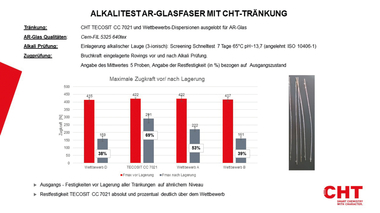
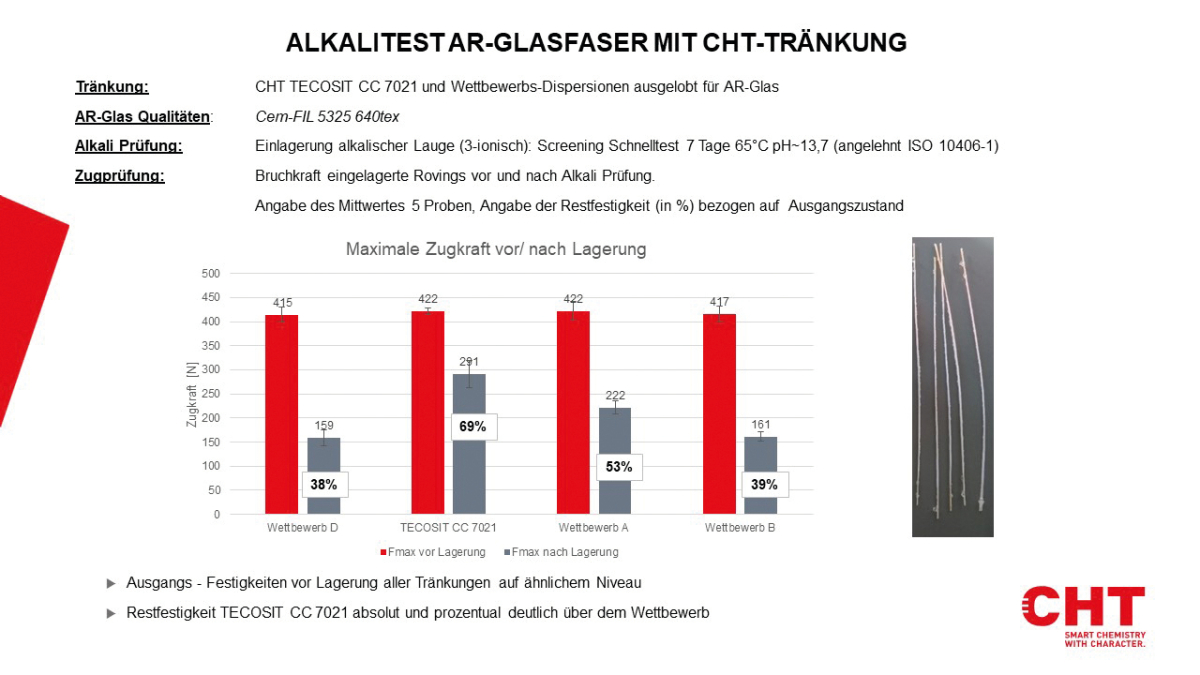
In the development and testing of Tecosit products, the focus is on processability in the textile process and on optimal composite properties in concrete. The advantage is particularly evident with AR glass fibers: the use of Tecosit CC 7021 significantly reduces the reduction factors (see Fig. 1). This considerably increases durability and enables higher production reliability and a longer service life for glass fiber reinforced products. In addition, the reinforcement is economically optimized by a lower number of layers.
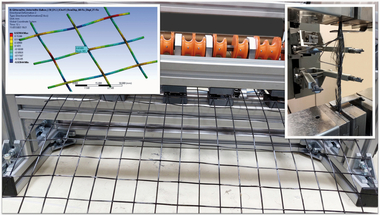
When used on carbon fibers, the appropriate Tecosit impregnations enable breaking strengths of over 3,000 N/mm in the carbon grid – even under the influence of moisture, over long periods of use, and in a wide temperature range. This means that these specially equipped carbon grids can also be used reliably outdoors. The achieved design values are significantly closer to the theoretical strength values of the carbon fibers. This leads to a more economical use of carbon reinforcement and increases planning reliability. Fig. 2 shows an excerpt of the performance characteristics of a common carbon fiber impregnated with Tecosit CC 1000. The thermoformability of the cured polymer dispersion makes Tecosit CC 1000 unique for carbon. With this technology, a three-dimensional geometry – such as a shear grid – can be produced from a flat textile with little effort, even though the rigid carbon grid has high composite strength. Even complex geometries can be manufactured individually by specialized companies according to requirements.
Successful showcase projects
CHT Tecosit technology has already been used to construct buildings that are considered showcase projects. This was only possible thanks to the commitment of the building owners, planners, and contractors. Carbon textile technology contributes significantly to reducing CO₂ emissions in new and existing construction projects.
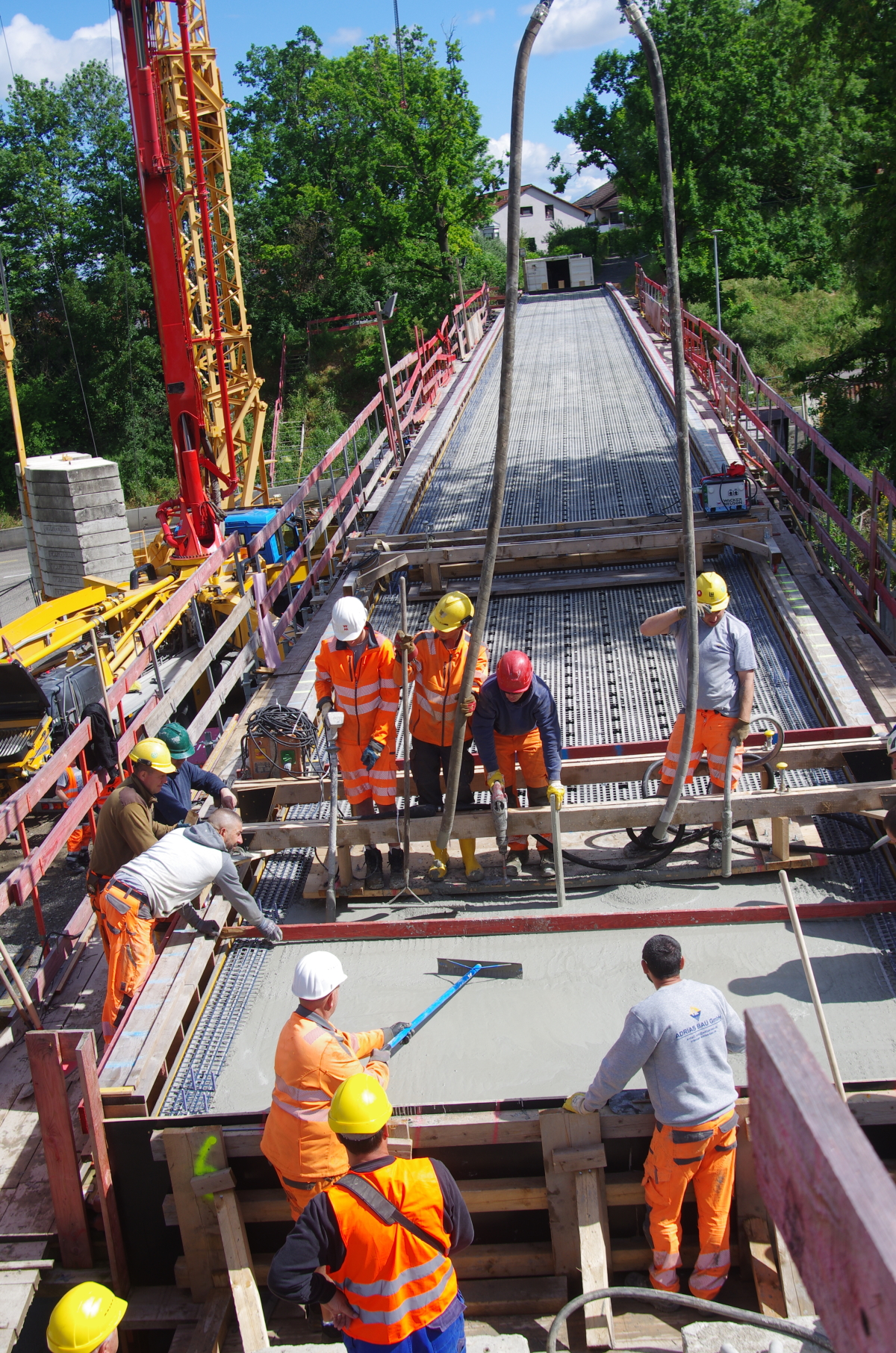
An outstanding example is the wood-carbon concrete bridge in Stuttgart, built in May 2024. The innovative design combines a carbon concrete deck with a wooden girder structure and makes optimal use of the strengths of both materials. The result: a slim, resource-saving construction. The required carbon reinforcement covered around 4,000 m², which was equipped with Tecosit CC 1000 in several layers and partially modified with surface-enlarging properties.
Shortly before concreting, another advantage of carbon textile reinforcement became apparent: due to the low weight per unit area of the textile, the use of cranes was hardly necessary. The individual layers could be positioned in the formwork by self-unrolling. The meshing of the grids was carried out ergonomically directly above the reinforcement layer using disposable cable ties.
Since no metal reinforcement was used in this bridge construction, the typical risks of reinforcement corrosion are eliminated. This means lower maintenance and renovation costs over the entire service life of the bridge compared to conventional constructions.
Various possible applications
Another project is the semi-precast bridge over the BAB 1 motorway near Davensberg, which was built in June 2023. It is characterized by high overall durability, especially in the area of the bridge caps. Sensitive structural components were protected by impregnating carbon textile molded parts with Tecosit CC 1000, thus avoiding costly renovations. The bridge is one of the longest prestressed concrete bridges without a central pier in Germany and was completed in just four months – half the time required for conventional construction methods.
In collaboration with TU Dortmund University and the precast manufacturer EUDUR-Bau GmbH & Co. KG, practical noise barrier elements with reduced shell volume (less than 35% compared to reinforced concrete) were developed. This saves sand and cement, reduces the carbon footprint, and offers logistical advantages. The greatest contribution to sustainability lies in the extended service life, as non-metallic reinforcements do not corrode. Carbon fibers are resistant to aging, alkaline attack, and chloride-induced corrosion.
As a partner in the Carborefit consortium, the CHT Group offers solutions for the retroactive reinforcement of components – many of which are approved by building authorities. Further applications are emerging in gardening and landscaping, prefabricated construction, and sealing systems.