

CO₂ reduction through upcycling of waste concrete


Everox is bringing an industrially scalable upcycling process to market that enables waste concrete to be fully converted into high-quality substitutes for cement and aggregates. By reactivating cement paste and reintegrating all material fractions, the process opens up new potential for low-CO₂ and circular concrete production.
Everox, a pioneer in sustainable building material processing, is bringing its patented technology to market. The Everox process transforms waste concrete into high-quality substitutes for cement, sand, and gravel, enabling a largely circular use of concrete for the first time.
The resulting upcycled materials contribute to reducing CO₂ emissions and landfill waste, while protecting natural resources. Everox aims to make a measurable contribution to reducing global CO₂ emissions by substituting primary materials.
Reactivating cement paste instead of producing new
The Everox process differs fundamentally from conventional recycling processes in that it not only recovers aggregates but also reactivates the cement paste contained in the concrete. This represents a significant savings potential, as cement production accounts for around 8% of global CO₂ emissions. The cement paste activated via the Everox upcycling process can be used as Supplementary Cementitious Material (SCM) and replace up to 30% of the cement in new concrete.
“Our mission is to phase out virgin materials in concrete,” says Thomas Petithuguenin, CEO of Everox. “By reactivating cement paste and reintegrating it into the material cycle, the need for new cement can be significantly reduced.”
Industrial flagship plant for scalable upcycling
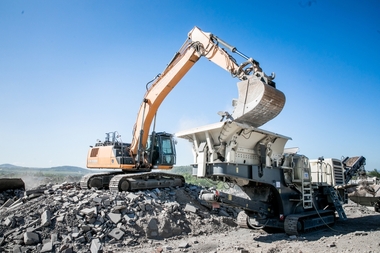
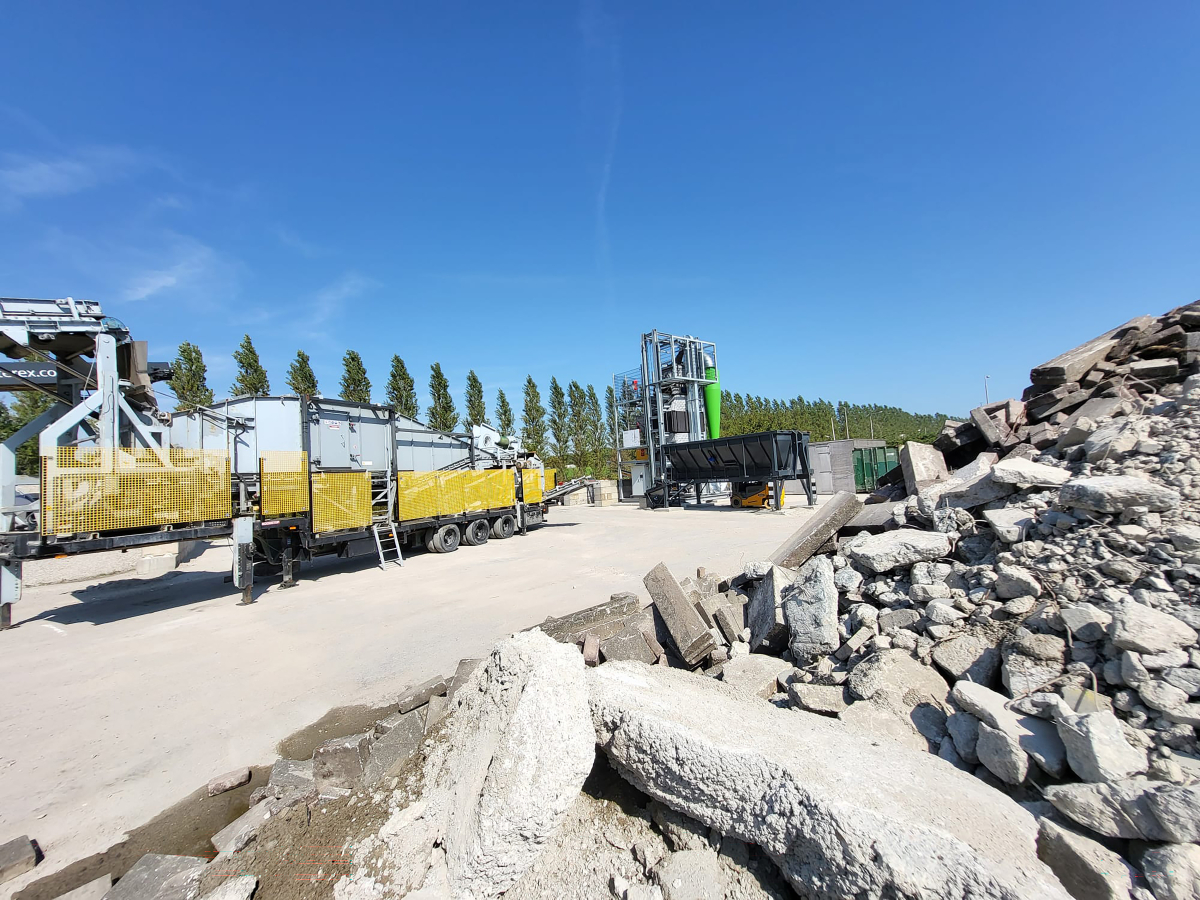
With the Concrete Upcycling Plant, Everox is launching its first industrial-scale plant onto the market. The plant can process up to 500,000 tons of concrete waste per year. Upcycling one ton of cement paste generates around 90% fewer CO₂ emissions compared to primary cement. At the same time, no residual waste is generated, as the concrete waste is fully processed.
The plants are designed to be compact and can be deployed both permanently and temporarily, for example in regions with damaged infrastructure. This reduces transport distances and strengthens regional material cycles.
Depending on operational requirements, the plant can be operated in single-shift (8-hour) mode or continuously (24/7), while maintaining dust emissions below 5 mg/m³. A modular dry process - comprising crushing, separation, and activation stages - ensures the recovery of all material fractions:
Cement paste is processed to Activated Cement Paste,
Gravel is processed to Recycled Coarse Aggregates,
Sand is processed to Recycled Fine Aggregates and Fine Inert Filler.
All materials meet technical requirements and are comparable to primary raw materials in terms of both cost and performance. The market launch is supported by product certification to provide planning security for architects, construction companies, and concrete producers and to facilitate the use of low-CO₂ building materials.
Sustainability along the entire value chain
With more than 3.5 billion tons of concrete waste generated globally each year, there is significant potential for CO₂ reduction. Everox therefore collaborates with construction companies, recyclers, and concrete producers to establish the technology internationally.
By using Activated Cement Paste, the CO₂ footprint of new concrete is reduced, as energy-intensive cement production is partially avoided. At the same time, replacing primary gravel and sand helps to protect natural ecosystems. Local processing and shorter transport routes further reduce logistics emissions and strengthen regional material cycles.
First applications and proof of concept
Several proof-of-concept applications have already been realized. In the “Living Lab” on the south pier in IJmuiden (Netherlands), eleven concrete blocks made from different Everox formulations are exposed to real North Sea conditions. The best-performing formulations achieve a compressive strength of 52.3 MPa after 28 days, corresponding to strength class C40/50.
Since 2022, more than 1,000 tons of waste concrete have been processed at the pilot plant in Hoorn, demonstrating the scalability and effectiveness of the process. Further projects include applications in Ukraine as part of the S3RoU consortium and the use of Everox materials in the Circular Arch Bridge in the Green Village at Delft University of Technology.
Material testing in the Everox Garden
At its test center, the “Everox Garden” in Rotterdam, the company operates a pilot plant and laboratory for material analysis. The plant replicates the industrial process at pilot scale. Customer-specific materials are processed and analyzed to evaluate their upcycling potential, enabling reliable yield forecasts and material quality assessments.
The Everox Garden serves as an interface between research, development, and industrial application, supporting partners in evaluating technical and economic feasibility.
Scaling in the Netherlands and internationally
A joint venture established in 2024 with Dura Vermeer is currently developing the first commercial flagship plant in the Netherlands. It will process around 100,000 tons of concrete waste per year. Over the next three years, Everox plans to build seven additional plants in Europe, the United Kingdom, and Canada.