

North-west Merano bypass, Küchelberg tunnel, and cavern garage: Precise concrete logistics for tunnel construction
26.01.2026
 Figure: Konsortium San Benedetto – Merano Scarl
The Merano north-west bypass, with the Küchelberg tunnel and cavern garage, is one of South Tyrol's most important infrastructure projects. The aim of this major project, which will take around six years to complete, is to relieve inner-city traffic, improve regional accessibility, and enhance the quality of life in Merano. With a total length of 2,210 m, an internal tunnel diameter of between 12 and 16 m, and an almost equal distribution of loose material (approx. 1,070 m) and rock (approx. 985 m), this tunnel construction project is an outstanding achievement from both an infrastructural and a technical point of view.
Figure: Konsortium San Benedetto – Merano Scarl
The Merano north-west bypass, with the Küchelberg tunnel and cavern garage, is one of South Tyrol's most important infrastructure projects. The aim of this major project, which will take around six years to complete, is to relieve inner-city traffic, improve regional accessibility, and enhance the quality of life in Merano. With a total length of 2,210 m, an internal tunnel diameter of between 12 and 16 m, and an almost equal distribution of loose material (approx. 1,070 m) and rock (approx. 985 m), this tunnel construction project is an outstanding achievement from both an infrastructural and a technical point of view.
The second construction lot of the bypass connects to the first section, which was completed in 2013, and continues the tunnel from Merano railway station under Goethestraße and Zenoberg to the industrial area of Tirol. A new roundabout is being built there with connections to Passeier, Dorf Tirol, and Obermais. To ensure that traffic flow in this area was not affected during the construction phase, the challenging jet grouting method was chosen, which was applied to a 1 km long underground section. A cement screen was injected in advance to stabilize the tunnel face. This allowed the rock and loose rock to be gradually removed underground by excavator or blasting. Jet grouting in loose rock was slow going in some places. The tunneling under Goethestraße alone took almost three years.
A superlative project
Following a specification in December 2016, the construction work was formally handed over in October 2020; the first blasting took place in March 2021, and the breakthrough on April 17, 2025. From November 2020 to September 2025, Beton Lana supplied the concrete for this extraordinary construction project. Over a period of five years, around 500,000 tons of tunnel excavation material was transported to the Beton Lana premises, where it was processed and delivered back to the construction site in 24-hour shifts. A total of 200,000 m³ of concrete has been delivered to date.
The complex geology and inner-city location presented a host of technical, logistical, and environmental challenges. The interface with the existing urban infrastructure was particularly demanding in terms of planning and operation. For example, a new roundabout including bridge renewal over the Passer river had to be integrated and a direct connection to a planned cavern garage in the city center had to be created. Further challenges for Beton Lana included processing large quantities of shotcrete and raw materials, complying with strict quality requirements, and at the same time planning logistics in such a way that traffic, noise, and emissions in the sensitive urban environment were kept to a minimum.
Sustainability thanks to innovative circular economy
The project was particularly resource-efficient because a large part of the excavated material from the tunnel construction was processed into concrete aggregate and reused in the tunnel. However, the challenge was that the excavation and concrete requirements did not usually coincide in terms of timing. The quantity and requirements therefore had to be reassessed and coordinated on a daily basis – a logistical masterpiece by Beton Lana and the San Benedetto – Merano SCARL consortium, which includes the companies Carron Bau, Mair Josef & Co. and P.A.C. In addition, there were high quality control requirements. The very heterogeneous excavated material had to be cleaned and processed at the Beton Lana plant so that concrete of consistently high quality could be delivered throughout the entire construction phase.
Efficient logistics and raw material management convince the client
Beton Lana proved to be a key partner in this technically demanding project and contributed to the successful implementation of the Küchelberg Tunnel and the Merano North-West Bypass with a comprehensive service package. The initial strategic coordination with the client was crucial. “Our original plan was to set up a temporary concrete plant on the construction site for supply. With its extraordinary logistics concept, Beton Lana convinced us to supply us from its existing plant in Lana,” says Christian Lechner from the San Benedetto – Merano SCARL consortium. “We transferred the logistical responsibility for concrete requirements and material quality to Beton Lana and are very satisfied with this decision.”
Quantities and logistics
Between November 2020 and September 2025, Beton Lana delivered a total of around 200,000 m³ of concrete, including approximately 70,000 m³ of shotcrete. Around 20,000 m³ of this was used for the cavern garage. These delivery quantities corresponded to around 20,000 truckloads and a pump volume of over 100,000 m³ – figures that required a high degree of logistical precision and a permanently available fleet of vehicles. In order to cover night and weekend requirements, Beton Lana set up a 24-hour terminal on its premises: Around 25,000 m³ were loaded at night and on Sundays and public holidays so that the San Benedetto – Merano SCARL consortium could collect the material independently. This organization reduced waiting times, avoided traffic peaks in the city, and ensured continuous construction progress regardless of the time of day.
Quality assurance and laboratory
Another success factor was comprehensive quality management. In total, Beton Lana carried out around 1,500 laboratory tests both directly on the construction site and in the concrete plant. Continuous monitoring of fresh and hardened concrete properties, consistency, and additive dosing was particularly essential for shotcrete, as it is subject to the highest requirements in terms of adhesion, layer thickness, and strength in tunnel construction sections with variable ground conditions. Constant coordination between the construction site, laboratory, and plant enabled rapid recipe adjustments—a decisive factor for efficiency in blasting and open tunneling.
Raw material management and sustainability
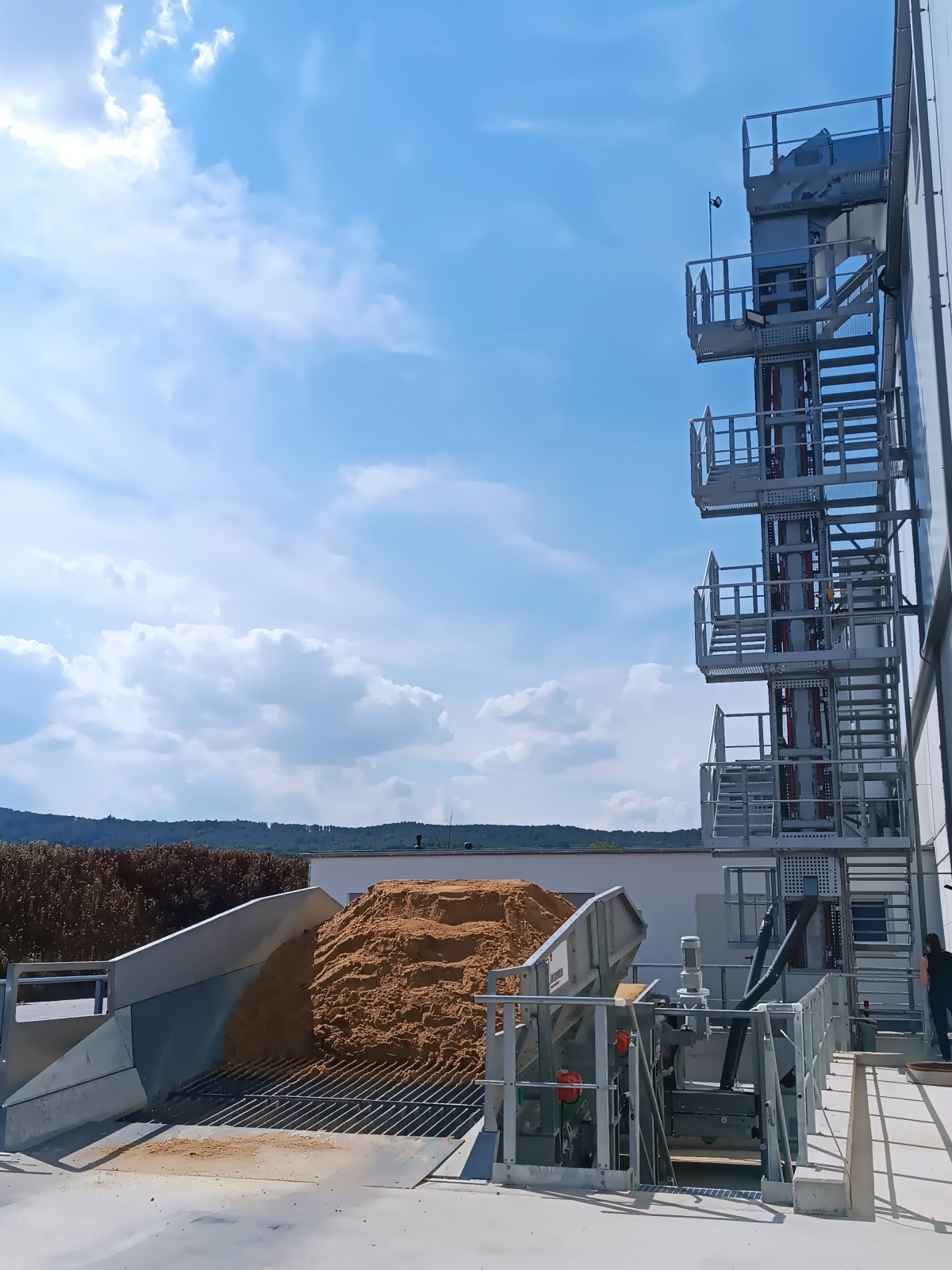
Beton Lana also rented two additional plots of land for the temporary storage of large quantities of rock and earth material and organized the material logistics there. The excavated material was efficiently organized and recycled at the 10,000 m² storage site. A total of approx. 500,000 m³ of excavated material was processed at the Lana site. This targeted raw material logistics reduced the need for external material deliveries, lowered transport costs and emissions, and made an important contribution to sustainable material recycling.
Technical services for shotcrete
The volume of around 70,000 m³ of shotcrete illustrates the central role of this technology in the project. Shotcrete enables temporary stability, ensures rapid securing after blasting, and is an integral part of the construction of escape routes and open-air starting sites. Beton Lana not only supplied the material, but also developed the recipes and provided technical support on site. This included close coordination with the foremen of the three construction site groups in the area of the Dorf Tirol roundabout. This ensured the smooth and safe execution of the necessary shotcrete work.
Outstanding teamwork as the key to success
Behind these technical achievements was a high level of organizational competence. The smooth running of the project required close coordination between sales, plant control, the laboratory, fleet management, warehouse logistics, and construction site support. It was precisely this multidisciplinary teamwork that was the key to success: only through continuous communication, rapid responsiveness, and clearly defined responsibilities was it possible to meet the complex requirements in terms of quantity, quality, and timing. Beton Lana thus demonstrates how a regionally based supplier can make a decisive contribution to a major project through technical expertise and active teamwork – especially under the demanding conditions of an urban environment and challenging geology.
“We are proud that by taking on a large part of the concrete supply, we were able to make a significant contribution to ensuring that the tunnel driving and the associated construction phases were completed on schedule and to a high standard of quality,” says Christian Grünfelder, Managing Director of Beton Lana. “The flexible round-the-clock delivery was a real challenge for our team, but at the same time it gave us a wealth of valuable experience. After this project, we feel equipped to tackle any logistical challenge.”
CONTACT
Beton Lana GmbH
Peter Anich Straße 12
39011 Lana/Italien
+39 0473 057100
RBW Rohrdorfer Betonwerke
Lanhofen 7
84367 Zeilarn/Germany
+49 8572 9684-0