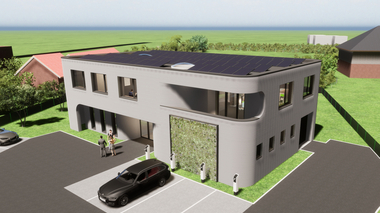



ViliaSprint²: Europe’s Largest 3D-Printed Apartment Building Completed in France
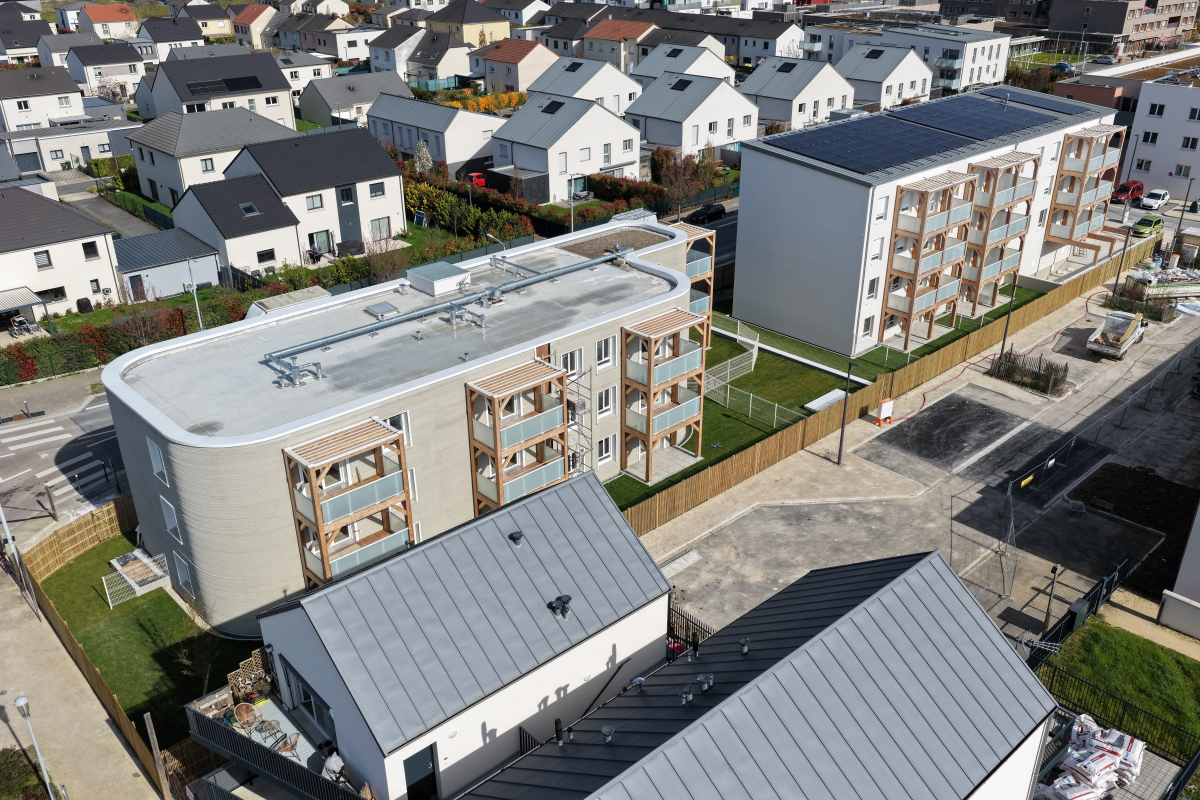 Figure: Plurial Novilia
 Figure: Peri 3D Construction
 Figure: Peri 3D Construction
 Figure: Peri 3D Construction
 Figure: Peri 3D Construction
 Figure: Peri 3D Construction
 Figure: Peri 3D Construction
 Figure: Plurial Novilia
3D concrete printing is making its way into multi-story residential construction. With ViliaSprint², an apartment building was constructed in France whose load-bearing structure was printed entirely on-site. The project demonstrates the technology’s potential in terms of construction time, labor costs, and construction workflow, while also serving as a comparison to conventional construction methods.
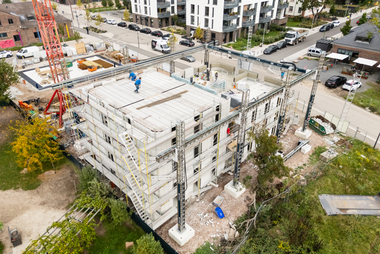
Plurial Novilia, a subsidiary of the Action Logement Group and manager of more than 39,000 apartments in the Grand Est region and in Île-de-France (Seine-et-Marne and Essonne), has completed the ViliaSprint² project in Bezannes (Marne department). The apartment building, comprising 12 social housing units, is the first building in France whose load-bearing structure and all walls were produced directly on-site using 3D concrete printing.
With a total living area of 800 m² spread over three floors (ground floor plus two stories), it is also the largest building of its kind in Europe. Against the backdrop of declining new construction activity and a persistent shortage of skilled workers in physically demanding trades such as structural work, the project was completed in 12 months (all trades, excluding infrastructure). It demonstrates the potential of a process that could, in the future, help create housing more quickly and with modified construction processes, while improving working conditions on the construction site and safety.
A pioneering project for multi-story residential construction in France
Plurial Novilia already has experience in this field (in 2022, five houses with factory-printed walls were handed over) and is now expanding the application of additive manufacturing in the construction industry.
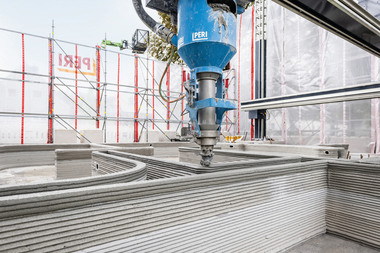
The 3D printing was carried out directly on the construction site using a Cobod BOD2 robotic portal system from Peri 3D Construction, which creates the load-bearing exterior and interior walls by extruding concrete layer by layer. The printable concrete—developed by Holcim based on TectorPrint technology—was reinforced with synthetic macrofibers to improve its structural properties. It belongs to the CO₂-reduced ECOPact series and enables an emissions reduction of at least 30% compared to conventional concrete.
Thanks to the technology and on-site production of the concrete, the printing phase, which began in March 2025, was completed in 34 effective days—faster than the originally planned 50 days. This time savings is also attributable to an optimized sequence for installing the precast slabs, which reduced the number of necessary repositionings of the printing gantry.
“This achievement confirms the potential of this construction method, which can both shorten construction times and transform working conditions on the construction site—for the companies involved in the printing process, Holcim and Peri 3D Construction, as well as for the general contractor Demathieu Bard Construction,” explains Jérôme Florentin, Director of Project Development at Plurial Novilia.
A demonstration project for the industrialization of 3D printing in construction
In addition to the technical implementation, the project aimed to test the conditions for using 3D printing on the scale of an apartment building within France. To this end, Plurial Novilia constructed a nearly identical building using conventional construction methods on the same plot of land. This second building serves to compare the performance of 3D construction both during the construction phase and in operation.
The results show not only shorter construction times for the shell but also differences in productivity and working conditions. For example, 3D printing required three operators, while traditional construction required six people.
By printing the load-bearing walls directly on-site, there is no need to shift production to factories; at the same time, the requirements for construction trades are shifting toward more technically and digitally oriented tasks. Operators control the process via tablet and do not have to lift heavy loads. This can increase safety and reduce physical strain.
The materials and equipment required are also reduced: instead of formwork and walkways, the robot and scaffolding are primarily used.
Environmental aspects and architectural possibilities
The technology reduces the expected amount of waste (from 10% to 5%) and decreases the volume of transport, as the concrete is processed on-site. Additionally, the construction site is quieter.
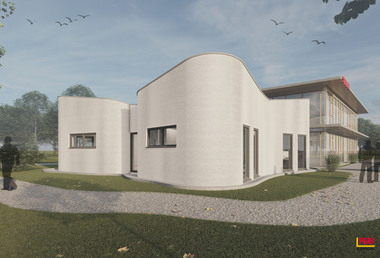
3D printing allows for greater design freedom, particularly with complex geometries and curves. Thanks to a compact design and optimized shapes, approximately 10% of the concrete was also saved.
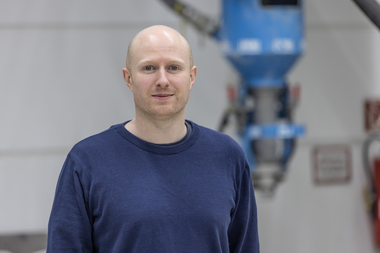
“At Peri 3D Construction, we are involved in implementing this project as a technology partner and in the printing process. The result demonstrates what is possible in 3D building printing—even in France: faster construction, reduced labor requirements, and load-bearing structures. For us, this is an important step in the further development of this technology,” says Dr. Fabian Meyer-Brötz, Managing Director of Peri 3D Construction.
Contribution to current challenges in residential construction
The architectural concept by Hobo Architecture also integrates bio-based and geo-based materials such as perlite (for insulation) and wood for balcony structures. The building is complemented by 500 m² of photovoltaic systems and a hybrid gas heat pump from Atlantic Systèmes.
The building’s orientation is based on solar studies by German expert Timo Leukefeld and enables approximately 60% energy self-sufficiency while complying with the French RE2020 requirements for 2025.
With a construction period shortened by three months, the project represents an approach to addressing the housing shortage in France. Construction costs are currently about 30% higher than those of conventional construction methods (without affecting rents), mainly due to research and development expenses as well as certifications. The total investment amounted to €4.5 million.
“ViliaSprint² is a step toward testing new construction methods and demonstrates the potential of 3D printing for housing construction,” said Johnny Huat, CEO of Plurial Novilia.
Building on this experience, Plurial Novilia is planning another project with approximately 40 residential units in collaboration with its partners. Two 3D printers will be used simultaneously to further reduce construction time and bring costs closer to those of conventional construction methods in the long term.
CONTACT
Peri 3D Construction GmbH
Rudolf-Diesel-Straße 19
89264 Weißenhorn/Germany
+49 7309 950 6096