

Reinforced concrete jacking pipes for the conversion of the Berne system in Essen/Mülheim
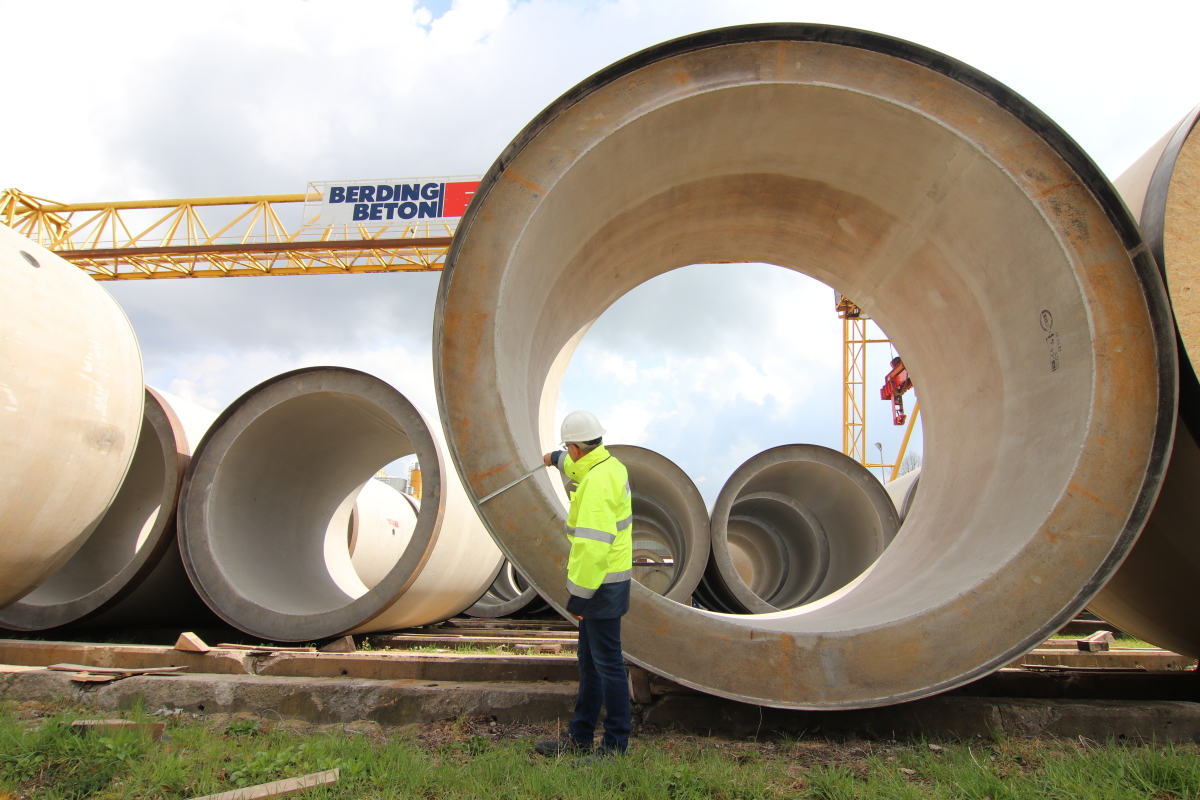 Figure: Berding Beton
 Figure: Berding Beton
 Figure: Berding Beton
 Figure: Berding Beton
 Figure: Berding Beton
 Figure: Berding Beton
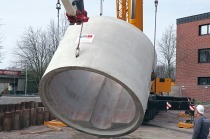
For the conversion of the Berne system in Essen/Mülheim, Berding Beton supplied, among other things, 3,500 m of reinforced concrete jacking pipes with diameters ranging from DN 400 to DN 3800, with the total weight of the large pipes alone amounting to 31,000 t. In addition, there were frames, standard shafts, standard superstructure components, lowering shafts, and a vortex shaft.
It was a construction project of special proportions: the ecological improvement of the Emscher and its tributaries, which were freed from municipal wastewater with the help of large-volume sewer structures laid in the floodplains. The Emscher is a tributary of the Rhine, over 83 km long, which flows through the Ruhr area. Until the middle of the 20th century, the Emscher was considered the dirtiest river in Germany, as sewage from mining and industry, as well as all domestic sewage, had been discharged into the river since the 19th century.
The Emscher has been free of wastewater since the beginning of 2022. In a process that took decades, the former „stinking Köttelbecke“ has been transformed into a new river landscape with blue water and green banks, opening up new space for flora and fauna. A key element in the successful renaturation was the installation of the new 51 km long Emscher sewage canal (AKE), which now carries all wastewater underground to the two large sewage treatment plants in Bottrop and Dinslaken.
For the successful renaturation of the Emscher, it was necessary to ensure that all tributaries were also free of sewage. One of these tributaries is the Berne, which, together with its own tributaries, forms the Berne system and flows through the urban areas of Essen, Bottrop, and Mülheim. As the main river of the city of Essen, it is relatively unknown, which may be due to the fact that it runs largely underground. With a catchment area of around 60 km², the Berne system provided central drainage for the Essen urban area and, to a lesser extent, for Mülheim an der Ruhr and Bottrop. Immediately following the above-mentioned AKE construction project, work began on the conversion of the Berne system in Essen and Mülheim with the aim of also removing the wastewater load from the waterways here.
€130 million invested
The Emschergenossenschaft, whose tasks include the maintenance of the Emscher, wastewater disposal and treatment, and flood protection, invested around €130 million in the conversion of the Berne system. In doing so, it also had important aspects such as creating a balance between the different usage requirements of humans and nature in mind.
In order to collect municipal wastewater and prevent it from flowing into the Berne and its tributaries, a new underground sewer line was laid over a distance of around 20 km. The sewer beds in this sub-area lie at depths of between approx. 6 and 13 m below the water table. The average gradient of the main sewer is approximately 3%. Reinforced concrete pipes with diameters between DN 2000 and DN 3800 were laid along the main sewer route. Pipes with diameters between DN 300 and DN 3000 were used for the connecting sewers.
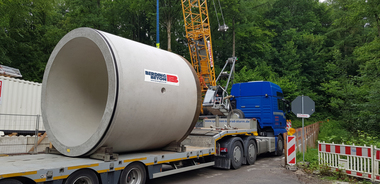
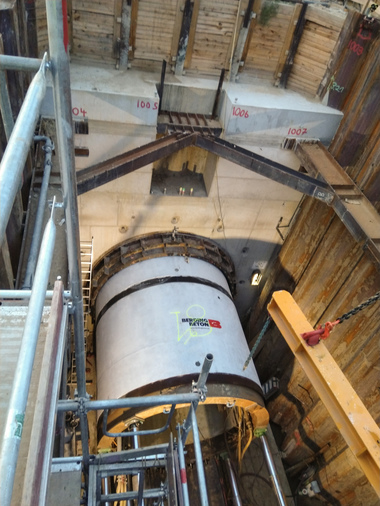
One of the last sections of this extensive project was located in Essen at Sulterkamp, where the Borbecker Mühlenbach flows into the Berne. For this section, „Berne sewer with construction of a storage sewer with bottom drainage (SKU E) Sulterkamp,“ the company Berding Beton supplied 3,500 m of reinforced concrete jacking pipes with diameters ranging from DN 400 to DN 3800. The total weight of the large pipes alone, at 31,000 tons, placed high demands on logistics. Due to their excessive width, all transports to the construction site had to be approved for the relevant routes and could only take place at night. A maximum of four to six pipes were delivered per night, with an additional escort vehicle required to secure intersections, junctions, driveways, and similar hazards during transport. Close coordination between the manufacturer Berding Beton and the contractors ensured smooth delivery to the construction site.
Construction expertise was also required to lay the large-volume main collectors at depths of 6 to 13 m in the densely populated metropolis of Essen. A controlled pipe jacking method was used for this purpose. The planning for this extensive project was in the hands of the planning consortium Afry Deutschland GmbH (formerly Pöyry), Essen, and Hydro-Ingenieure GmbH, Düsseldorf. The construction work was carried out by the experienced engineering and civil engineering company Eiffage Nordwest GmbH from Wallenhorst. Eiffage Infra-Spezialtiefbau GmbH from Nuremberg and Smet Tunnelling n. v. from Düsseldorf were responsible for the pipe jacking. Sweco GmbH from Cologne was responsible for construction supervision.
Precast elements instead of planned in-situ concrete
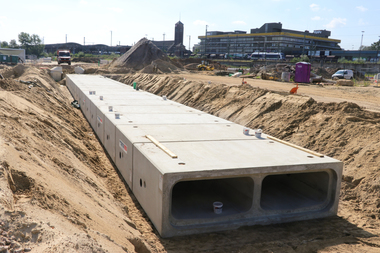
In addition to the reinforced concrete jacking pipes, Berding Beton supplied structures, frames, standard shafts, standard superstructure components, lowering shafts, and a vortex shaft, all of which were custom-made to meet the requirements of the Emschergenossenschaft. For example, the precast construction method recommended and implemented by Berding Beton enabled size optimization for the vortex shaft, which was specified as in-situ concrete. Thanks to the elements prefabricated at the factory, the construction time was significantly reduced and costs were saved. Furthermore, the client benefited from the synergies within the Berding Beton group of companies, which is very well positioned with its 60 locations in Germany and the Netherlands. The various specialized plants work closely together, pooling their expertise.
The three supplying plants in Stendal, Möhnesee, and Dortmund coordinated with each other for the manufacture and completion of the entire vortex shaft. Since reinforced concrete components had to be combined with parts made of polymer concrete, Meyer-Polycrete GmbH, which belongs to the Berding Beton Group, contributed its expertise in the field of polymer concrete. At the Stendal site, it manufactured downpipes (DN 1000) and a connection to the existing sewer in polymer concrete. The reinforced concrete structures, such as the vortex fall shaft, were produced by Caspar Hessel GmbH, also part of the Berding Group, at its site in Dortmund. The Berding plant in Möhnesee contributed specially reinforced DN 1200 shaft rings.
The vortex chute is used for wastewater control. It ensures a steady flow velocity and converts energy, thereby protecting structures and reducing noise through an orderly air flow. During drainage, the wastewater is brought into a swirling or spiral motion via the upper so-called screw structure and thus controlled. In this way, it is discharged over a large difference in height with low energy consumption. The spiral-shaped inlet creates a centrifugal, swirling descent along the downpipes. This swirling motion slows down the water and converts the potential energy into an orderly air flow in the center of the shaft, reducing noise and erosion on the walls.
Decades of experience and expertise
Thanks to decades of experience and expertise, Berding Beton was able to provide the client with comprehensive advice on the optimal product selection in intensive discussions. The Emschergenossenschaft‘s tender specified concrete pipes with increased acid resistance (SWB). Berding Beton‘s compliance with the high requirements defined for the concrete was closely monitored by the Emschergenossenschaft. This was done both in advance by testing the pipes in question and through quality assurance measures, which involved continuous monitoring of the ongoing production processes. Manufacture in smooth steel formwork with long curing times means that the reinforced concrete pipes have a high strength class (C50/60), very smooth surfaces, and low manufacturing tolerances. This is of great benefit in the tunneling process. Another advantage is that the pipes are designed for a maximum external pressure of 2.7 bar thanks to specially designed pipe connections and a DS special seal.
The construction period for this section took just under two years. Thanks to intensive cooperation between the client, planner, construction company, and pipe manufacturer in the run-up to pipe production and delivery, it was possible to ensure a reliable and trouble-free supply of high-quality pipes for the construction project. As a result, everyone involved was very satisfied with the outcome.
After completion of this work, the renaturation of the river landscapes could be further advanced. The near-natural design and ecological enhancement opens up new habitats for flora and fauna. But it also creates new local recreation and leisure opportunities for people. For example, new footpaths and cycle paths have been created along the riverbanks. In summary, it can be said that the conversion of the Berne system as part of the Emscher conversion project, which spans generations, is an important building block for the sustainable improvement of the quality of life and leisure in the Ruhr area.