


Exposed concrete for balconies at the “Grünblick” residential high-rise


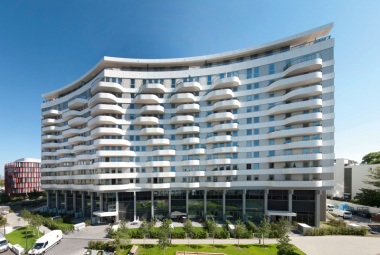
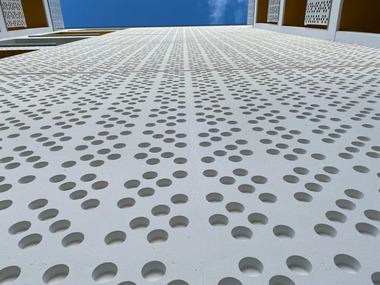
The “Grünblick” residential high-rise skillfully combines sustainability, high living standards, and appealing aesthetics. The project team planned several communal areas within the building, including a sauna with a panoramic view, an outdoor pool on the roof, and other amenities. It was also important to them to design the architectural details in an appealing way. This is particularly evident on the undersides of the balconies and their parapets. These are made of colored concrete that was textured using formwork matrices from NOE-Betongestaltung.
“Grünblick” is located in Viertel Zwei – an important urban development area in Vienna – and has been awarded the ÖGNI Gold Certificate. It represents a successful combination of sustainable construction, exclusive living, and an appealing façade design. The 90-meter-tall building has a gross floor area of over 51,000 m² and a three-story underground parking garage. A total of 340 condominiums are housed across 28 above-ground floors. Units ranging from 1.5 to five rooms and spanning approximately 44 m² to 134 m² are available. All apartments feature high-quality finishes. The ground floor features a concierge service and five commercial units. However, the highlight of the project is on the roof. There, residents can enjoy not only an impressive view but also a dining room with a terrace and a wellness area featuring a pool, fitness area, and sauna. The construction company Strabag served as the general contractor for the project. Its employees handled the turnkey construction of the residential high-rise and managed all construction services.
Design
The design of the high-rise was developed by the firm Mario Cucinella Architects in Bologna, which won a design competition among ten invited firms. A defining feature of the building’s architecture is the staggered arrangement of floor slabs, from which the similarly staggered balconies emerge. These balconies have a distinctive feature: their undersides and parapets are made of colored concrete, whose surface is textured using formwork matrices. When deciding which manufacturer should supply the matrices for this project, NOE-Betongestaltung was chosen from the outset. Strabag had already collaborated with the company on another project. Those involved in the construction were extremely satisfied with both the molds and the associated service. The company’s molds are PU mats that can be customized with virtually any relief pattern. They are equipped with a fiber mesh on the back, which enhances their dimensional accuracy. This is particularly important in the face of temperature fluctuations and when the molds are reused multiple times. Depending on the design, they can be used up to 100 times. This reduces costs with each application.
To transfer the desired pattern onto the concrete surface, simply secure the textured mats in the formwork to prevent slipping. The concrete can then be poured in. Once it has cured, the mold can be removed, revealing the desired surface texture. NOE’s molds are suitable for use both in precast concrete plants and on construction sites. Both application methods were used at Grünblick: For the larger balconies – i.e., at the building corners – the project team placed the molds directly into the formwork on-site and poured the concrete. In all other cases, the Rauter precast concrete plant – a specialist in exposed concrete surfaces – first produced 6 cm thick precast slabs. These were then used on-site as permanent formwork. The parapets were also installed alongside them, which were supplemented with in-situ concrete and structurally connected.
Balcony underside and parapets
The designers had very specific ideas regarding the concrete’s appearance. They specified a terracotta-like shade. To achieve this, the precast plant created various color samples using white cement and pigments. The project team then reviewed the results and determined the concrete mix design. The choice of surface texture for the concrete was selected with equal care. The NOE standard range, with over 180 design templates, served as the basis. The planners selected one from this range. Sample panels were also produced for this. However, their surface textures did not meet the planners’ expectations. For this reason, the standard design was modified. This then achieved the desired result. This was only possible because, in addition to its extensive selection of standard designs, NOE also offers the ability to realize custom requests.
Once the key parameters – such as the concrete mix and surface texture – had been finalized, Strabag created a mock-up measuring approximately 6 x 5 meters. It was exposed to the elements for several weeks, allowing for the assessment of any potential color changes. It was crucial that the undersides of all balconies in the 340 apartments consistently maintained a similar color scheme and surface finish. The project team successfully overcame this major challenge, primarily thanks to their excellent collaboration. Both Strabag employees and those from the Rauter precast concrete plant praised NOE’s commitment to the project.
Text: Dipl.-Ing. Claudia
El-Ahwany