

current knowledge, challenges and opportunities

Service life forecast for concrete
Overview

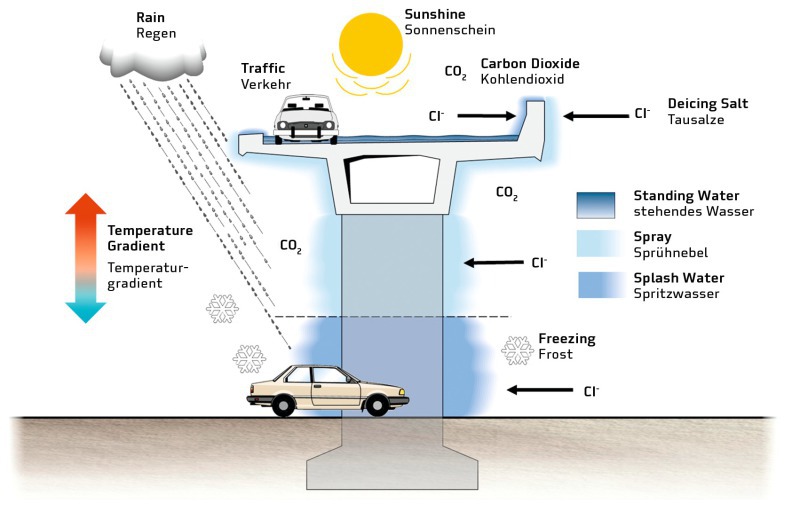
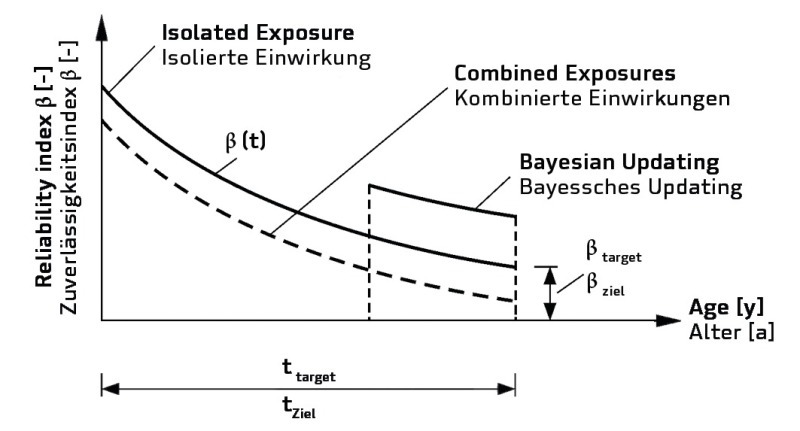
Concrete structures are exposed to complex actions with an influence on durability that may lead to substantial damage during their service life, which has been increasingly observed in transport infrastructure in the recent past. Service life forecasts provide the opportunity to estimate the expected progression of damage in concrete in order to initiate timely maintenance and repair measures. Service life forecasts essentially rely on damage models and probabilistic methods, such as specified in the fib Model Code for Service Life Design [1]. This paper outlines current practice with...


Related articles:

Issue 02/2017 Low-clinker cements

A forecast model for the carbonation of concrete

Producing concrete as a bulk construction material is associated with several significant environmental impacts, which are mainly attributable to the Portland cement clinker contained in the cement....

more
Issue 02/2017 New findings and forecast models

Freeze-thaw attack and damage

The freeze-thaw damage pattern of concrete is primarily linked to the water contained in the pore system, which is also referred to as the saturation level. If a certain critical saturation level is...

more
Issue 02/2020 Working with BIM

Rehabilitation of precast reinforced-concrete elements

Model-based 3D structural software (BIM software) has been available to builders, planners, building contractors and the trades for some years now. BIM (Building Information Modeling) is a digital,...

more
Issue 01/2011 Particle Models

Damage simulation in heterogeneous materials

On the macroscale, the key dimensions of the structural component define the characteristic dimension of the model. Since these dimensions are usually considerably larger than the dimensions of the...

more