


Europe's largest modular construction project
27.02.2026
 Figure: Schöck Bauteile
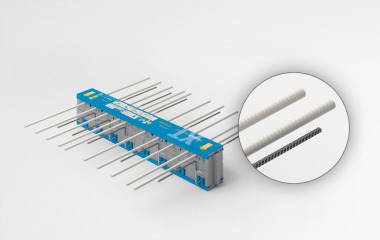
The new construction project on Berlin's Landsberger Allee is the largest modular construction project in Europe to date. It could represent a new approach to social housing if the aim is to create sustainable, affordable, yet high-quality living space quickly. Schöck Isokorb T S proved to be the ideal solution for attaching the steel balconies. In view of the special requirements of modular construction, the load-bearing thermal insulation element is particularly notable for its simple, quick and retroactive installation.
Figure: Schöck Bauteile
The new construction project on Berlin's Landsberger Allee is the largest modular construction project in Europe to date. It could represent a new approach to social housing if the aim is to create sustainable, affordable, yet high-quality living space quickly. Schöck Isokorb T S proved to be the ideal solution for attaching the steel balconies. In view of the special requirements of modular construction, the load-bearing thermal insulation element is particularly notable for its simple, quick and retroactive installation.
A new residential district is being built on a 39,400 m² site in Berlin's Friedrichshain-Kreuzberg district, which was previously vacant, on behalf of the state-owned Berlin housing association Gewobag. The ensemble, comprising four large seven- to eight-story buildings, is intended to create affordable living space for people on low to medium incomes and students. The majority of the 1,548 residential units, ranging from one-room apartments to five-room apartments, are subsidized and therefore subject to occupancy restrictions. The design is by klare-Architektur, Berlin. Numerous balconies and a 6,800 sqm outdoor area designed as a park ensure a high quality of life. This is enhanced by the complex's integration into an established neighborhood with attractive infrastructure and good connections to the city center.
Cost-effective modular construction
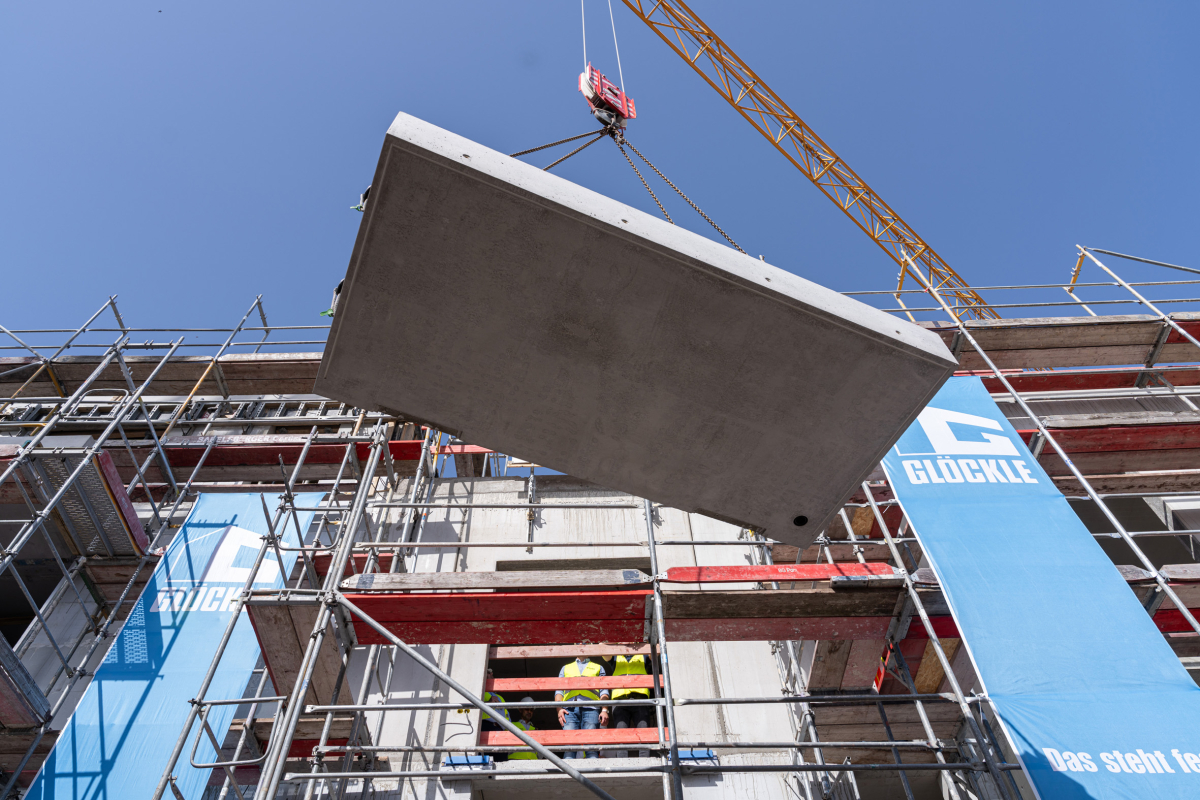
The buildings are constructed using cost-effective modular construction and consist of over 3,000 modules for various apartment types. The Dutch-Japanese construction company Daiwa House Modular Europe GmbH, based in Bochum, is responsible for the implementation. Thanks to prefabrication in the factory and simple on-site assembly, construction projects using modular construction can be completed 50% faster.
High degree of prefabrication
Production takes place in a steel frame construction in a new Daiwa factory in nearby Fürstenwalde. A concrete floor is poured into a form-giving steel frame, which is then bolted to the surrounding steel scaffolding, closed with drywall elements and insulation, and then delivered to the construction site as an almost ready-to-move-in room module. The one-room apartments come as a complete unit and only need to be assembled. In the case of larger residential units consisting of several modules, the joints between the room transitions must also be closed on site. “We achieve a degree of prefabrication of up to 90 percent with our modules and can erect the buildings quickly,” says Hans Edwin-Luca Erdmann, Head of Engineering at Daiwa.
Schöck as a proven partner
The 759 free-cantilevered balconies were also planned efficiently. These are steel structures that are simply bolted to the steel frames of the modules. "In the modular system, screw and plug-in solutions simplify the processes. That's what we rely on,“ explains Erdmann, who turned directly to Schöck in his search for a suitable connection solution and found it in Isokorb T S. ”Why change a system that you know and that has proven itself? The product is approved by the building authorities, we have certainty in the thermal bridge calculation, and Schöck is a reliable partner," he explains, adding: “When you use Schöck Isokorb, no one asks any questions because everyone knows that the quality is absolutely fine.”
Schöck Isokorb T S as the ideal connection solution
Erdmann also cites the screw connection as a decisive factor in choosing Schöck Isokorb, as it "is ideally suited to the requirements of the modular system. It can also be pre-installed at the factory, which increases the degree of prefabrication. All that remains to be done on the construction site is to screw the balconies in place, which in turn saves a lot of time.“ The building element also scored points with its possibility of retroactive and flexible installation during construction, ”as we can only install the balconies on Landsberger Allee after the facade has been completed."
André Brendel, installation supervisor at Schöck, who provided advice on the adjustments in the prefabrication plant and the installation on site, sums up: "The collaboration with Daiwa went smoothly. The employees on both sides worked very professionally and efficiently to find the best solution for the construction project. Individual adjustments were no problem, as our products are ideally suited to Daiwa's requirements: they are designed for fast, flexible, and economical construction."
Facade construction requires a special solution
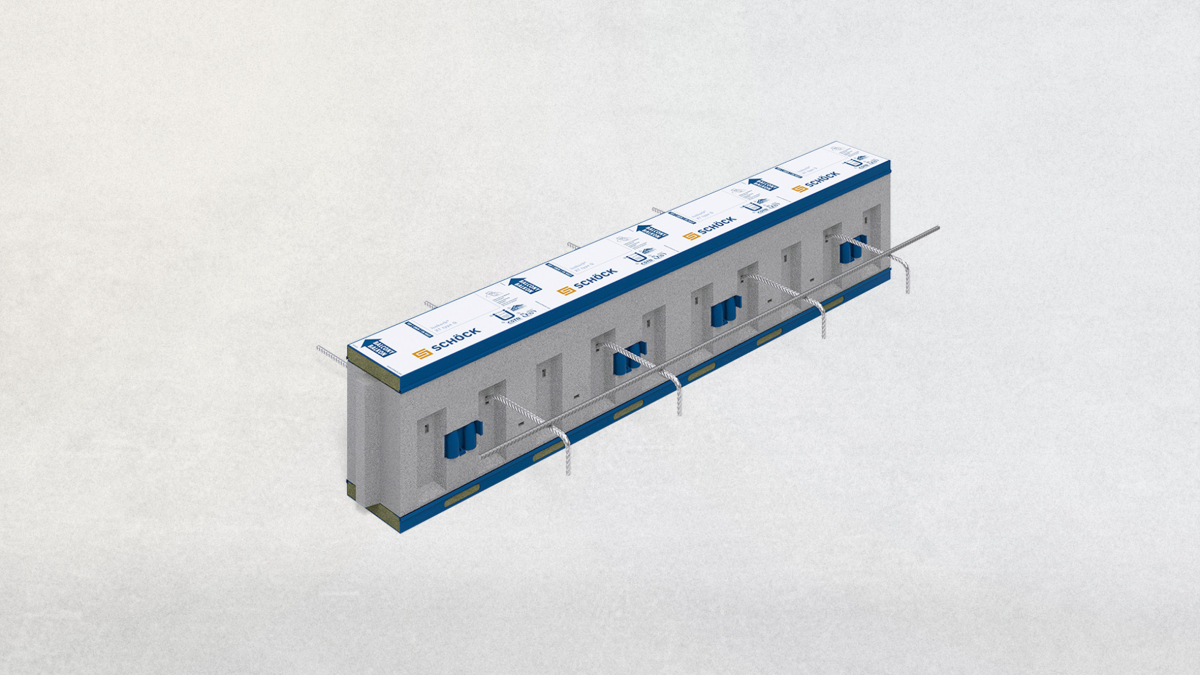
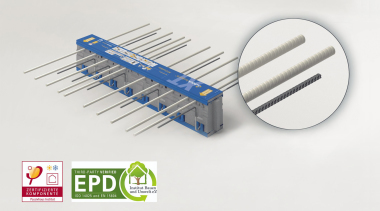
Isokorb T S is a load-bearing thermal insulation element for free-cantilevered and supported steel structures with connection to steel components. The element consists of the S-N and S-V modules and, depending on the module arrangement, transfers moments, shear forces, and normal forces. The connection between the components is made using continuous threaded rods. However, the Landsberger Allee project required a special solution because the facade structure with plaster and thermal insulation meant that a greater distance had to be bridged. "Normally, you place the components to be docked and the Isokorb as close as possible to the load-bearing structure. The threaded rods of Isokorb T S are therefore also designed for this use of Schöck Isokorb. In the case of Landsberger Allee, however, the connection point of the balcony construction is shifted forward by approximately six to eight centimeters due to the facade," says Carl Pöting, civil engineer at QTP at Ingenieurgesellschaft für Bautechnik Kröger-Bretländer mbH, Bochum, one of the two offices commissioned with the structural design, describing the challenge.
Schöck Isokorb T S offers the necessary flexibility
The bridging was solved by means of a steel adapter component and the extension of the threaded rods. The calculations had to take into account the higher load resulting from the larger lever arm. The aim was to reliably ensure the load-bearing capacity despite the introduction of higher forces into the supporting structure. "We had to work within the approval limits with the special solution and have the necessary geometric adjustments confirmed by Schöck. The structural engineer also had to agree. Ultimately, it was a matter of creating the same conditions from a structural point of view as those specified in the approval,“ explains Pöting, referring to the favorable conditions provided by the modular design of the component: ”It was helpful that Isokorb T S has a wide range of applications and has a lot of potential in this regard. The steel construction connection proved to be very flexible." The adaptation went smoothly: the deviation calculation for the threaded rods, which were longer than those specified in the approval, could be made on the basis of a simple design basis. Since the extension of the threaded rods did not constitute a significant deviation, static verifications were sufficient for this custom-made product.
Pre-installation of Isokorb at the factory
To avoid transport damage to the protruding threaded rods, only the upper Isokorb, the S-N module that absorbs the tensile forces, was completely pre-installed at the factory. For the S-V module attached at the bottom, which transfers the compressive and shear forces, a special contact plate was screwed to the surrounding U-profile of the steel frame. This means that the Isokorb can be easily screwed to the end plate using this contact plate during the facade work on the construction site. Once the facade work is complete, each balcony is thermally separated and structurally connected to the internal steel frame using one S-N module and one S-V module on the right and left, i.e., a total of four modules.
Positive results
After completion of the first facade, two sample balconies were installed for testing purposes – with success: the modular design of Isokorb T S offered sufficient tolerances for precise alignment and, as expected, installation was completed quickly. A total of 757 additional balconies were produced by the steel construction company in the following weeks and then hung in front of the facade in one go.
Hans Edwin-Luca Erdmann's conclusion is correspondingly positive: “With Schöck Isokorb T S, we have achieved the perfect construction process: we can deliver and install the modules, then erect the scaffolding to attach the facade and then dismantle it again. The balconies can then be lifted into place flexibly and without supports and secured using a simple screw connection.” He can imagine using the proven Isokorb T S solution developed for this pilot project as the standard for Daiwa in the future. After all, national technical approval for the room modules as complete components is also planned in the long term.
CONTACT
Schöck Bauteile GmbH
Schöckstraße 1
76534 Baden-Baden/Germany
+49 7223 967-0