

Opportunities and risks of alternative, sustainable cements

What about the cement transition?
For several generations now, Portland cements have constituted the basis for the concrete model of success, a building material which, like no other, characterizes our environment and of which approximately 11 billion m³ have been used up in building last year. Why then should we work with other cements than with conventional Portland cements in the future? Can the future cements not just be that of the past?

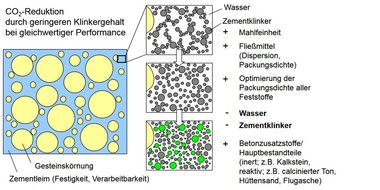
A quite essential reason for a needed cement transition are the substantial CO2 emissions which are associated with the production of classic Portland cement (1 t of Portland cement means...

Related articles:

Issue 02/2020 Concrete technology

Measures to reduce CO2 emissions

More than 6 % of the worldwide carbon dioxide (CO2) emissions caused by humans are associated with the production of cement and concrete. It is a known fact that a purposeful substitution of the...

more
Issue 03/2025

Future prospects in cement technology: What lies ahead?

Around 80 % of the CO2 footprint in concrete production results from cement production. Production of cement clinker, in particular, results in high specific CO2 emissions of 800 kg/t on the average....

more
Issue 04-2022/2022 DYCKERHOFF

Future of Buzzi Unicem cements is CGreen

The future of Buzzi Unicem cements is CGreen. A product line of sustainable cements has been created by know-how and innovation. Under the label of CGreen, Buzzi Unicem brings a new product line with...

more
Issue 11/2021 Tuesday, 16th November → New business opportunities (2)

CO2 neutral construction with concrete

The CO2 emission associated with cement and concrete are receiving increasing attention. Although the intrinsic emission of cement and concrete are low, the enormous volumes used – more than all...

more
Issue 05/2010 Sustainability starts from the building material

Study of micronized sand as a cement replacement

The environmental impact of infrastructure projects is becoming an increasingly important issue in engineering design. There is a growing pressure from governments and owners/clients to realize...

more