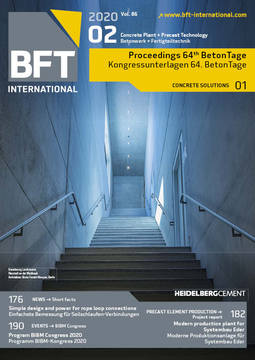


Think ahead!

With the high-tech strategy, the German Federal Government pursues the goal of interlinking the industrial production by means of modern information and communication technology. The technical basis for this initiative that is also summarized under the abstract concept of “Industry 4.0” is the intelligent and digital networking of systems, helping to make a widely self-organized production possible. Human beings, machines, equipment, logistics and products are communicating and cooperating directly with each other in Industry 4.0 and not only within one step of production, but also across the entire value-added chain.

The current study of the cement industry reveals that networking of production and digital communication technology has already been implemented within the cement manufacturing process to a great extent. The companies interviewed almost entirely record and transfer information digitally. An even higher degree of networking in the sense of Industry 4.0 has even been achieved at individual automated process steps, such as the production of cement clinker or the cement grinding, for instance. Today, these processes are widely controlled independently, with continuous monitoring at the control center. In general, workers actively intervene only in critical situations. The shortage of skilled labor, however, is a significant challenge when it comes to the implementation of Industry 4.0 in the cement industry. There is a lack of workers with background knowledge in information technology. The demand is constantly increasing. In the survey, the companies of the cement industry often criticized that internet bandwidth is too low at the factory locations and mentioned data security concerns as major obstacles for widespread use of network-based solutions (e.g., cloud services).

The increasing automation in the manufacturing process and the use of concretes through new technologies in the concrete and construction industries, such as the 3D printing and the change toward entirely digital modeling of buildings with the aid of “Building Information Modeling (BIM)” clearly indicate that “Industry 4.0” has also arrived in the downstream areas of the value-added chain.

In respect of all the technical benefits of digitalization, we must not forget that every building structure is unique, involving the intuition of the building owner, the creativity of the architect and the courage of the engineer. Whether it will be possible to replace the so-called “soft skills” by “artificial intelligence” in future, will turn out. We should critically question this foreseeable, forthcoming development and should not hand over the reins of power! For preserving the cultural heritage (and not the digital!) in construction, we must use the strength of our democracy that is based on involving and integrating all interests.

With this in mind, I wish you much pleasure in increasing your knowledge, and the organizers every success in running the event.

x

Related articles:

Issue 03/2026

From 3D concrete printing to digital construction sites – prospects for the construction industry of tomorrow

Additive manufacturing currently represents the most visible step on the path to digital construction. Concrete construction in particular demonstrates how materials, processes, and forms can be...

more
Advertorial / Advert

FROM THE DIGITAL CONSTRUCTION SITE TO THE ACADEMY: SAMOTER 2026 LOOKING AHEAD

The International Triennial Construction Equipment Exhibition returns to Verona from 6 to 9 May 2026 to showcase the latest innovations in the sector. Industry 4.0, digitalization, sustainability,...

more
Issue 04/2026 WIENERBERGER

CO₂-neutral concrete roof tile production facility in Hungary successfully commissioned

With an investment of around €30 million, Wienerberger, a leading provider of ecological and innovative building and infrastructure solutions, has given a sustainable boost to industrial value...

more
Issue 04/2026 FBF BETONDIENST/70. BETONTAGE 2026

70th Concrete Days in Ulm: Anniversary edition sets the tone for the future of the concrete and construction industry

For three days, the Congress Centrum Ulm once again served as the meeting place for the concrete and precast industry. From March 10 to 12, 2026, around 1,500 experts gathered for the 70th Concrete...

more