


New FDB Study on the Global Warming Potential of Prefabricated Concrete Industrial Building Structures
05.06.2026
 The graph shows the CO₂ values of the individual components for industrial building variants V1 through V9
Figure: FDB
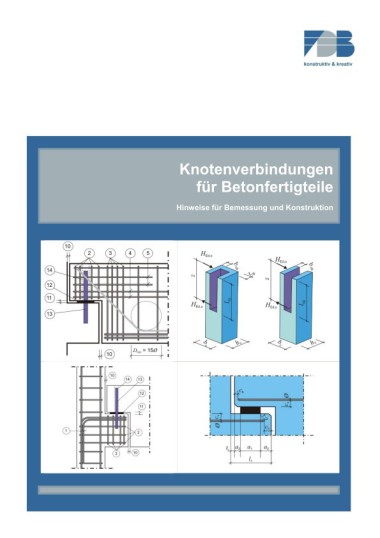
The German Precast Concrete Association (FDB) has published a new study titled “Greenhouse Potential of Precast Concrete Hall Structures” as part of its Sustainability Knowledge Series. The study examined 16 hall variants that differ in terms of geometry, use, and structural design.
The study shows that the global warming potential (GWP) of hall structures is significantly determined by the structural design concept and the quantities of materials used. Spans, truss spacing, building heights, load assumptions, and the design of columns and foundations have a noticeable impact on the results. The influence of the floor slab is particularly evident, as it makes the largest single contribution to the total GWP in most of the variants examined.
A key finding concerns the choice of reference parameter. While area-based parameters such as gross floor area can lead to distortions in buildings with varying heights, using gross volume as a reference more consistently reflects the functional performance of buildings. Particularly in tall buildings, usable volume and workspace are not adequately accounted for by a purely area-based analysis.
Material-efficient cross-sections are crucial
The analysis of material proportions confirms the dominant influence of concrete on the structural GWP. Its share in the examined variants exceeds 75%. Therefore, optimized structural design with material-efficient cross-sections is crucial for reducing the global warming potential. At the same time, the study shows that savings in reinforcing steel, which accounts for up to 18% of the GWP, can also make a significant contribution. Despite its higher specific material GWP, prestressing steel accounts for significantly less than 10% of the structural GWP due to the small quantity used.
The publication is aimed in particular at structural engineers, students, and manufacturers of precast concrete elements. It does not provide sample structural analysis but rather a systematic classification of typical factors influencing the greenhouse gas potential of industrial building structures made of precast concrete elements.
The new publication in the FDB Knowledge Series on Sustainability is available (in German) for free download on the FDB website.
CONTACT
Fachvereinigung Deutscher Betonfertigteilbau e. V. (FDB)
Schlossallee 10
53179 Bonn/Germany
+49 228 95456-56