


Vapor-permeable hydrophobic treatment of precast concrete elements


Water absorbed by capillary action transports dissolved salts to the surface, causing efflorescence and the streaks known as “water streaks,” binds dirt, promotes algae and moss growth, and increases the degree of saturation in the pore space near the surface. A hydrophobic impregnation treats precisely this are – without altering the precast concrete element’s fundamental vapor permeability.
For precast concrete elements used in retaining walls, support walls, and partition walls – or for decorative precast elements such as seating or large columns – customer satisfaction is rarely determined by load-bearing capacity, but rather by the appearance of the surface after storage, transport, and installation. The key factor behind this is water absorbed by capillary action: It transports dissolved salts to the surface, causes efflorescence and the streaks known as “water streaks,” binds dirt, promotes algae and moss growth, and increases the degree of saturation in the pore space near the surface. A hydrophobic impregnation acts precisely there – without altering the component’s fundamental vapor permeability.
The Easyblock System
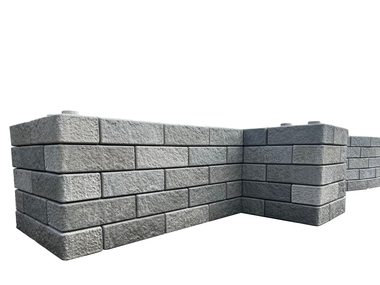
Easyblock is a modular retaining wall system made of large-format precast concrete elements weighing up to approximately 1,200 kg, developed by Easyblock GmbH, founded in 2022 in Carinthia.
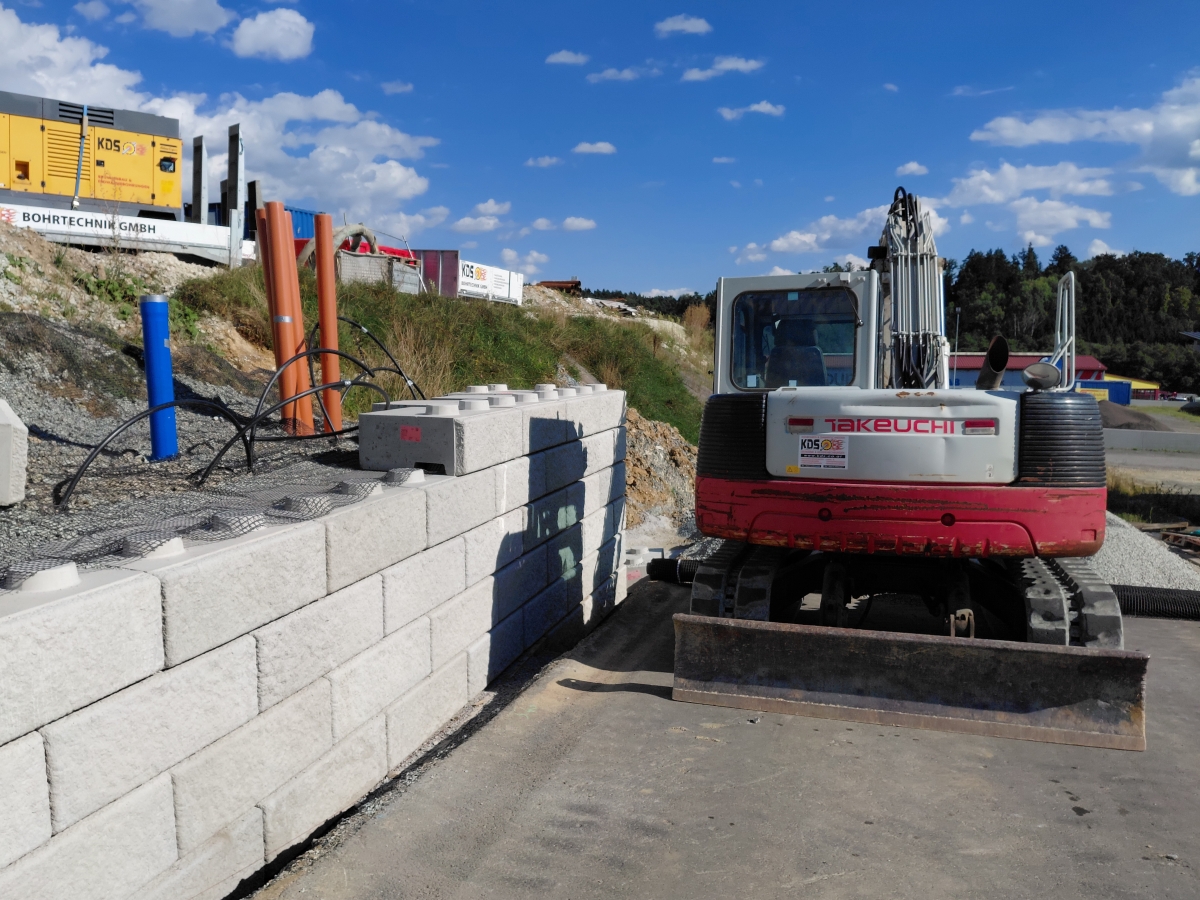
The concrete blocks are assembled dry, without mortar, using a precise tongue-and-groove system. As a result, Easyblock enables fast and flexible construction without curing times. With 23 coordinated block types and varying block depths, the system can be flexibly adapted to a wide range of structural and geometric requirements. Straight, curved, angular, and stepped wall configurations can be realized with the modular system. Depending on wall height, terrain, and load, the retaining walls are designed as heavy-duty structures or, for greater heights and higher loads, as geogrid-reinforced structures.
Structurally verified standard configurations are available for typical applications; in addition, project-specific solutions and wall heights exceeding 10 m can be implemented. Applications range from gardening and landscaping to slope and embankment stabilization, as well as lake and riverbank stabilization, all the way to infrastructure projects.
Various surface designs combine the structural function of a retaining wall with a high-quality appearance. Thanks to the dry, modular construction method, the concrete blocks can be removed, repositioned, and reused as needed.
A Deliberately Exposed Surface
The manufacturing process of the system is relevant to the issue of surface protection. The exposed surfaces are formed using polyurethane texture molds (Wasa Stonecast, Gneiss 3 category), based on a large-format, coarsely textured crust slab, among other templates; up to ten different texture templates ensure a varied appearance, and the 90° corner blocks are intentionally designed without a construction joint. The result is a natural stone look that is true to the original – and thus a deeply textured surface that is significantly more pronounced than a smooth formwork surface. Depending on the mold used, corresponding exposed concrete finishes are also possible.
With 3CS ConGuard Hydro Surface 606, this elegant appearance can be permanently protected and preserved right at the factory!
How diffusion-open impregnations work
Hydrophobic treatments based on reactive silanes and siloxanes do not act as a barrier layer, but rather as a vapor-permeable protection. The active ingredients penetrate the open pore space, react there with the mineral substrate, and form a hydrophobic, water-repellent protective film on the concrete surface and within the pores, thereby significantly reducing capillary suction.
The pore cross-section remains open, allowing water vapor to continue diffusing outward without forming a closed film layer. A precast element with residual moisture from production can therefore continue to dry out – unlike with film-forming sealants, where vapor buildup can lead to blistering, delamination, and efflorescence.
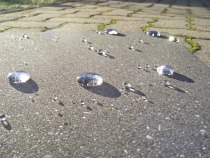
The added value for precast elements when using 3CS ConGuard Hydro Surface 606 is the greatly reduced capillary water absorption, a massive reduction in water-transport-related lime efflorescence, lower saturation levels in the edge zone, and, as a result, reduced stress during freeze-thaw cycles; Reduced dirt adhesion and less algae growth result in a uniform appearance after exposure to moisture and weathering. The effect is visible after approximately 24 hours: Rain beads off the treated surface instead of being absorbed.
3CS ConGuard Hydro Surface 606 – Specifications
3CS ConGuard Hydro Surface 606 is a solvent-free emulsion concentrate based on reactive, organo-modified siloxanes, tested in accordance with EN 1504-2 Class I. Since 2026, the product has been listed in the Austrian building materials database Baubook, which facilitates its use in specifications with ecological criteria and in funding contexts.
Advantages of the product for the applicator
The application timing is particularly noteworthy. Surface hydrophobization treatments are traditionally applied to cured, partially carbonated structural elements – often requiring waiting periods of weeks, and in some cases only after the structure has been installed.
In contrast, the alkali-resistant chemistry of 3CS ConGuard Hydro Surface 606 allows for application shortly after formwork removal, as soon as the exposed surface is dry to the touch and clean. This shifts the protective treatment from the operational phase to the construction phase.
Application in Practice
Application can be done by spraying, flooding, brushing, or rolling. In practice, a simple hand-operated sprayer – such as a Gloria model – has proven effective: generous wet-on-wet application, ensuring even coverage of the exposed surface, edges, and chamfers. No spray system, no additional equipment, and no specially trained application team are required. The application rate must be determined through preliminary tests on the specific substrate, as absorbency varies considerably depending on the formulation, compaction, and matrix structure.
The economic driver: storage, transport, and installation
For precast plants, the main benefit – aside from the durability argument, which is relevant for concrete guardrails, for example – is primarily a logistical one. When there is a lack of indoor storage space, materials are stored outdoors, resulting in water runs and tracks caused by washed-away fine particles – a cause for complaints, even though there is no technical defect.
3CS ConGuard Hydro Surface 606 reduces contamination, vegetation growth, and efflorescence in storage, thereby decoupling production planning from weather conditions and space availability.
When installing hydrophobic blocks in wet conditions, the visible surfaces remain clean, and soil deposits can be removed more easily. For a system that already boasts a short construction time, independence from weather conditions is a positive side effect.
The System Concept
Based on current experience, the surface hydrophobic treatment with 3CS ConGuard Hydro Surface 606 is expected to remain effective for approximately five years when exposed to the elements. The treatment thus provides protection during manufacturing and the early stages of use, with additional benefits throughout the service life.
However, 3CS ConGuard Hydro Surface 606 can also be reapplied to an older precast element – or to one that has never been treated – after thorough cleaning. 3CS ConGuard Hydro Surface 606 can also be applied to paving, masonry, brick, or other mineral substrates. Depending on the color and material, a slight deepening of the color may occur. In any case, it is recommended to test the product on a small area first.
To ensure lasting protection throughout the component’s service life, different protective concepts can be combined. Water-repellent treatment of the concrete cross-section or corresponding mass water-repellent treatment of the concrete can further reduce water absorption within the concrete matrix and thus explicitly enhance long-term protection.
Test Application Instead of a Brochure
To experience the ease of application, as well as the mode of action and quality of 3CS ConGuard Hydro Surface 606, it is always recommended to test 3CS ConGuard Hydro Surface 606.
Since absorbency, texture, and color vary from plant to plant, pre-sampling is a standardized procedure in our collaboration with customers. 3CS supports prospective customers through its technical service for its own product, accompanies the first application run at the plant, and determines the application quantity jointly on-site. The water-repellent effect on the customer’s own project – applied by the facility’s own staff – ultimately serves as a more compelling argument than any test certificate. This is how Easyblock was also convinced, and the company now recommends to its licensees, upon request, a significant enhancement and additional protection for exposed visible surfaces using 3CS ConGuard Hydro Surface 606.
CONTACT
3CS GmbH
8273 Ebersdorf 226/Austria
+43 (0) 3333 / 41 241 26
Easy Block GmbH
9300 St. Veit an der Glan/Austria
+43 (0) 4212 5454