


Application for inspecting Paving Stones developed at Kortmann Beton


In the production of concrete blocks, every detail counts: even the smallest geometric deviations or color defects must be detected. Kortmann Beton produces over 100,000 paving stones every day, but with such high volumes, manual quality control is out of the question. The paving stone manufacturer therefore commissioned image processing expert Ibea to develop an application for inspecting paving stones in order to check them reliably and quickly and automatically sort out defective products. AT Sensors supplied the necessary 3D sensor technology for this purpose.
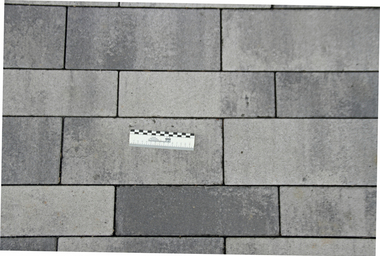
120,000 concrete pavers per day – that’s how many leave the Kortmann Beton GmbH & Co. KG plant in Schüttorf, Lower Saxony, every day. Each of these pavers must meet specific geometric and optical quality criteria before it moves on to the next stage of production. Given these volumes, it becomes clear why manual quality control reaches its limits. Fatigue, subjective assessments, and the sheer workload make it impossible to ensure a consistently high inspection rate for a total of 4,000 transport pallets, each carrying 30 blocks. At the same time, quality assurance in concrete production is a critical factor. Even the smallest deviations – such as deformations under 0.5 mm, micro-cracks, or texture irregularities – can cause assembly and installation errors, lead to customer complaints, and result in high costs throughout the entire manufacturing process.
The Concept of Optimization
This was precisely the situation Kortmann faced, so the desire to automate quality control for the concrete blocks arose quickly. The goal was to precisely and reliably inspect both the geometric shape and the color of the products. This was accompanied by the need to develop a system that operates reliably and consistently in the harsh production environment of a concrete plant without requiring operators to have in-depth technical knowledge.
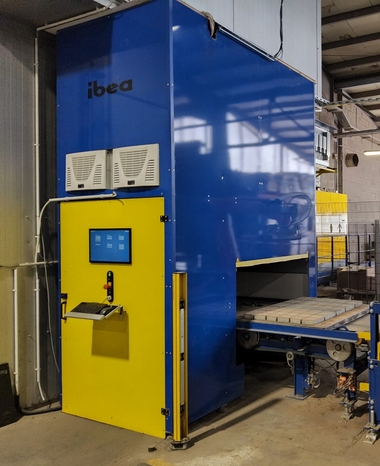
Ibea, based in Hamburg, served as the OEM responsible for developing the complete application, including vision and robotics software as well as system integration. As the end customer, Kortmann not only provided the production environment but also supported the development process with practical requirements and feedback from ongoing operations.
The Challenges
However, there were initially several challenges to overcome during the application’s development. With a volume of 4,000 boards to be inspected per day – each carrying around 30 blocks – the application had to be capable of detecting, analyzing, and, if necessary, marking each product for rejection in a matter of seconds. In addition, the team sought a sensor that would not only respond flexibly to the rough texture and varying grain patterns of the stones but would also cover a large field of view while still delivering submillimeter resolution. A color line scan camera (Basler) and a 3D triangulation camera (AT) were used, with a resolution of 4,096 pixels per line and a frame rate of up to 24 kHz.
The Sensor Selection
The high-precision triangulation camera projects a laser line across the stone, captures the height profile, and detects even the smallest geometric deviations – ranging from dimensions, shape, and angles to hairline cracks. “This application required a custom sensor solution that could be precisely integrated into the system designed by Ibea.”
Michael Newger, Head of Development at Ibea, adds: “Our decision to use AT sensors was no coincidence. We first relied on this technology back in 2014 because the resolution and functionality it offered were unmatched on the market – and, in our view, still are.” He continues: “Furthermore, the cameras are optimally designed for complex multisensor applications, such as those required in a concrete plant. The availability of various Scheimpflug configurations also allows for flexible adaptation to different inspection geometries and working distances.”
The software solution
Ibea developed software for this application that enables both pixel-precise analysis and intuitive operation. Detected defects are transmitted in real time to the inspection software, where they are automatically classified. At two lifting stations, a sorting robot replaces defective blocks with defect-free ones based on the information gathered. This ensures that production continues uninterrupted.
The development phase, from the initial concept to production readiness, spanned approximately six months. During this time, a prototype was created and extensively tested in live production. The focus was on optimizing the evaluation algorithms, adapting the robot control system, and precisely calibrating the sensor parameters until the system achieved the required process reliability.
The Benefits:
For Kortmann, the application delivers several key advantages. The system enables fully automated inline quality control that operates around the clock without requiring personnel and sorts out defective bricks in real time. With the help of the system, production defects were identified and eliminated. As a result, the level of rejects dropped to about one percent. At the same time, production interruptions, rework, and returns are significantly reduced, which saves costs and increases process reliability. The staff also benefits, as monotonous inspection tasks are eliminated. Furthermore, product quality can be seamlessly documented and specifically marketed – a clear added value for sales.