


BAU PreView 2027: Focus on productivity, existing buildings and affordable construction
30.10.2026
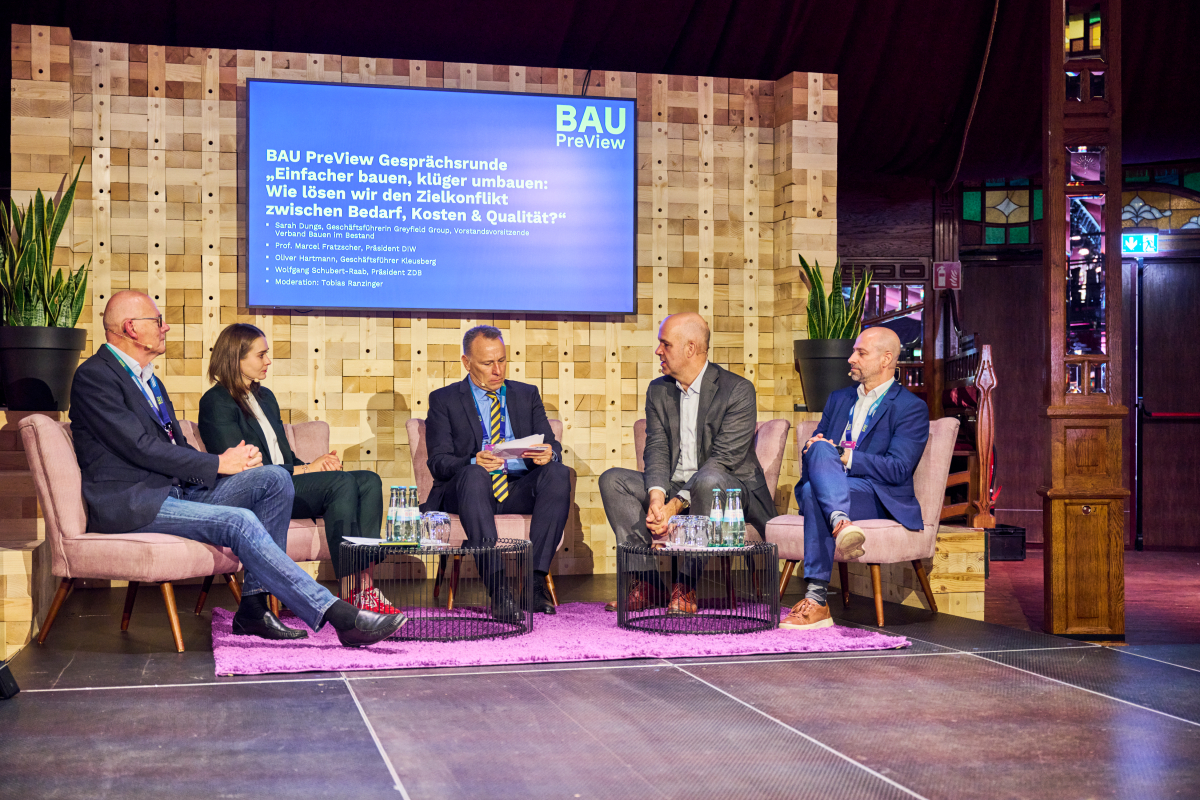 Figure: Messe München
About three months before the start of the world's leading trade fair for architecture, materials and systems, BAU PreView provided insights into the key themes, focal points and innovations of BAU 2027.
The focus included the economic conditions for construction and housing, as well as the question of how to build more simply, economically and resource-efficiently in the future. The opportunities offered by modular and serial construction methods and new production methods were also discussed.
Recent industry analyses highlight the urgent need for action in the construction sector: The Construction Monitor 2026 points to a housing shortage of approximately 1.35 million units and describes the decline in housing construction as a burden on the economy, employment and growth. At the same time, the Architecture Trend Report 2026 shows that housing requirements are also changing. There is a demand for flexible floor plans, multifunctional spaces, energy efficiency, healthy living environments, recyclable materials and a smart approach to existing buildings.
BAU PreView addressed these perspectives. A panel discussion with experts from architecture, the construction industry, the real estate sector and manufacturing explored current approaches to simpler, more economical and resource-efficient construction.
Construction and housing under economic pressure
In his keynote speech, Prof. Marcel Fratzscher, President of the German Institute for Economic Research, assessed the economic conditions for construction and housing in Germany. He focused in particular on the housing shortage, high construction costs and structural barriers.
Fratzscher identified key levers for change in faster permitting processes, lower construction costs, greater competition, higher productivity and a greater willingness to innovate within the construction industry. At the same time, he cautioned against speaking negatively about Germany as a business location: small and medium-sized enterprises, innovative companies and a high degree of adaptability continue to provide favorable conditions. The key, he said, is to consistently implement the necessary changes.
Modular and serial construction methods as potential solutions
How affordable construction can once again become faster and more productive was the focus of the panel discussion “Build Simpler, Renovate Smarter: How Do We Resolve the Conflict Between Demand, Costs and Quality?”
Representatives from business, the construction industry and existing building renovation discussed with Prof. Marcel Fratzscher where the greatest obstacles lie, whether in construction costs, regulation or lack of productivity. The discussion also focused on the relationship between new construction and existing buildings, the opportunities offered by modular and serial construction methods, dealing with standards and efficiency requirements, and the role of digitalization and new production methods in enabling faster and more cost-effective construction.
BAU Insiders present key themes for 2027
In addition to the discussion on current challenges and developments in the industry, BAU's brand ambassadors presented the trade fair's key themes using personal, real-world examples. Gerda Söhngen spoke about durable and resource-efficient solutions, while Christoph Krause emphasized the importance of digitalization and called for a faster pace of transformation. Julian Waning argued that products, systems and digital solutions should be integrated into planning processes much earlier.
BAU PreView concluded with a preview of the new trade show format BLACK BOX, which will make its debut at BAU 2027 in Hall B0. Participants were able to learn about translucent concrete samples and elements of a timber construction system, as well as see a construction robot in action up close.
CONTACT
Messe München GmbH
Am Messesee 2
81829 München/Germany
+49 89 949-20720