

Precast Concrete Foundations for the Energy Transition

The expansion of renewable energy is also opening up new areas of application for precast concrete construction. J. Lehde GmbH, in collaboration with the Düser planning office in Ense, has developed a precast foundation solution for battery storage systems. The Soest-based company received corresponding orders for three wind energy projects. In total, Lehde is producing approximately 120 point foundations made of reinforced concrete for this purpose.
The initial contact between the Düser planning office and Lehde took place in late April 2026. The partners then jointly developed a solution in which the required foundations are not cast conventionally on-site, but are first produced as precast reinforced concrete elements at the Lehde plant and then assembled quickly and precisely at the construction site. The orders were placed in early July. The foundations were manufactured from late July through September. The foundations are then picked up by the respective civil engineering contractors and installed on site.
“When dealing with a large number of identical components, prefabricated construction really allows its advantages to shine,” explains Dipl.-Ing. Rainer Hentschel, Head of Cost Estimating at J. Lehde GmbH. “The foundations are manufactured under controlled conditions in our plant. This enables us to achieve high dimensional accuracy and consistent quality. At the same time, it significantly reduces the workload on the construction site.”
These projects are part of a trend that is becoming increasingly important for the energy transition. The Düser planning office, in collaboration with wind turbine manufacturer Enercon, is constructing battery storage facilities in the immediate vicinity of wind turbines. Two current projects are underway in Soest-Meiningsen and Möhnesee-Westrich. According to the published plans, construction is scheduled to begin in late 2026; commissioning is planned for early 2027.
The principle is this: When wind turbines generate more energy than can be economically fed directly into the grid during periods of high electricity supply, a portion of the electricity can be temporarily stored. If demand rises again later, the stored energy can be fed back into the grid. Battery storage systems can thus help better align generation with consumption, stabilize the power grid, and prevent wind turbines from being shut down.
The Düser planning office sees this as a model for future wind energy projects. Speaking to the Soester Anzeiger, Andreas Düser explained that battery storage systems should be considered for every new project whenever possible in the future. The investment costs for the facilities in Soest and at Möhnesee are in the seven-figure range for each.
Lehde develops Foundations for Battery Storage Systems
In Möhnesee-Westrich, the storage facility is being built right next to existing wind turbines. The initial plan calls for a system consisting of three container units. According to the planning firm, the storage capacity is sufficient to absorb approximately two hours’ worth of electricity production from the wind turbines at full load.
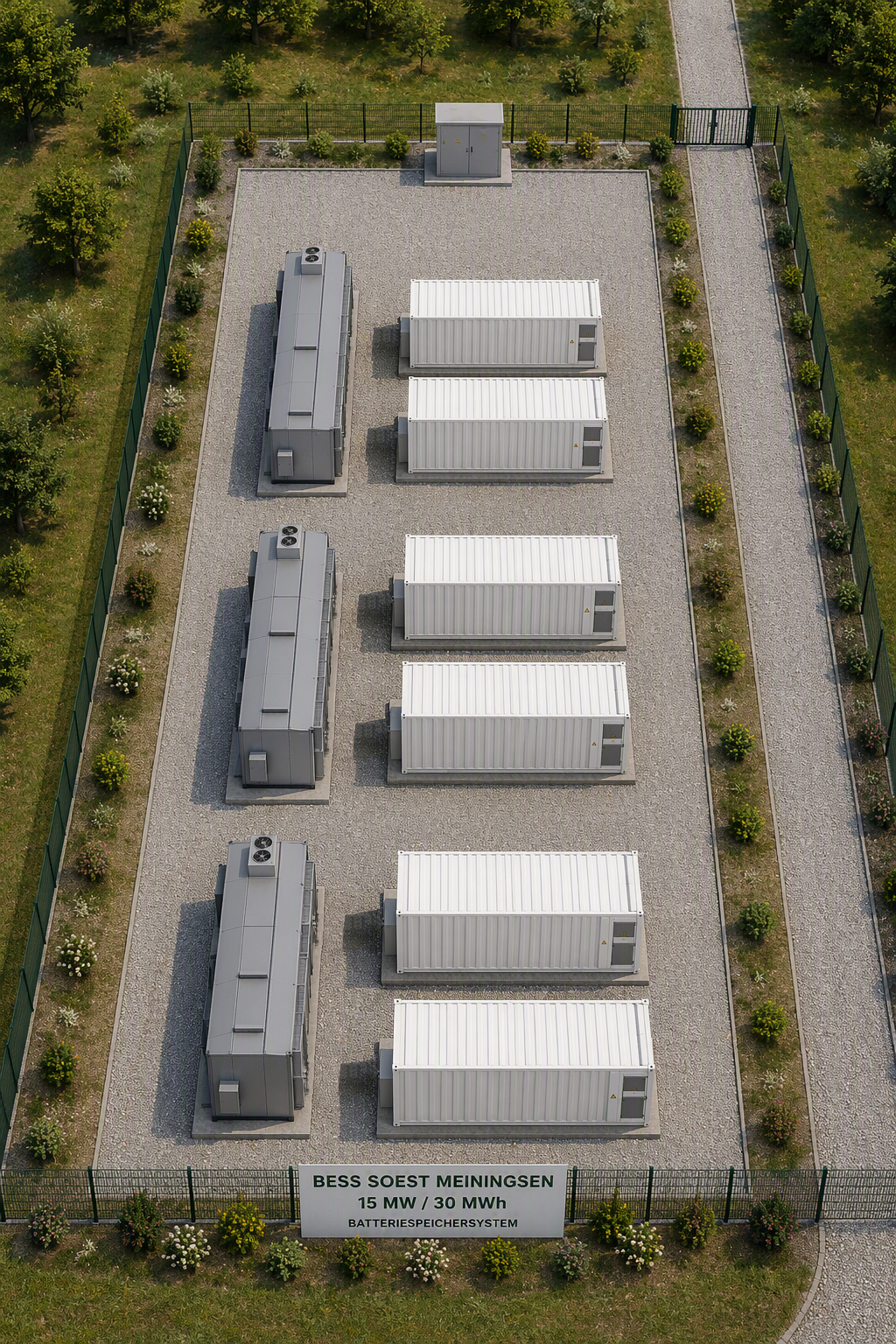
The facility near Soest-Meiningsen, north of Deiringsen on Meiningser Weg, will be approximately three times as large. The grid connection point through which wind power is fed into the grid is already located there. In addition, photovoltaic power flows into the grid at that location. The storage facility is designed to store approximately six hours’ worth of wind power generation. Unlike the initial project at Möhnesee, the Soest facility will also be able to purchase electricity from the market and later resell it. Both systems are designed to allow for future expansion.
Battery storage systems can not only improve the economic viability of renewable energy plants; in the long term, they can also help reduce the reliance on fossil fuel power plants for grid stabilization.
For Lehde, the project demonstrates how the potential applications of industrially prefabricated concrete components are evolving in line with the requirements of the energy transition. “We’ve been building structural frameworks and prefabricated components for industrial and commercial projects for decades. Now we’re seeing an application here that is directly linked to the transformation of our energy supply,” says Johannes Lehde, Managing Director of J. Lehde GmbH. “Especially when it comes to new technical requirements, it’s interesting to work with planners to develop solutions that can then be reproduced cost-effectively and with consistent quality. The 120 foundations demonstrate the potential of such standardized precast solutions.”
For Lehde, the contract thus also serves as an example of how traditional expertise in precast concrete construction can be applied to new infrastructure projects.