

New concrete block manufacturing facility
at Finnish manufacturer Rudus
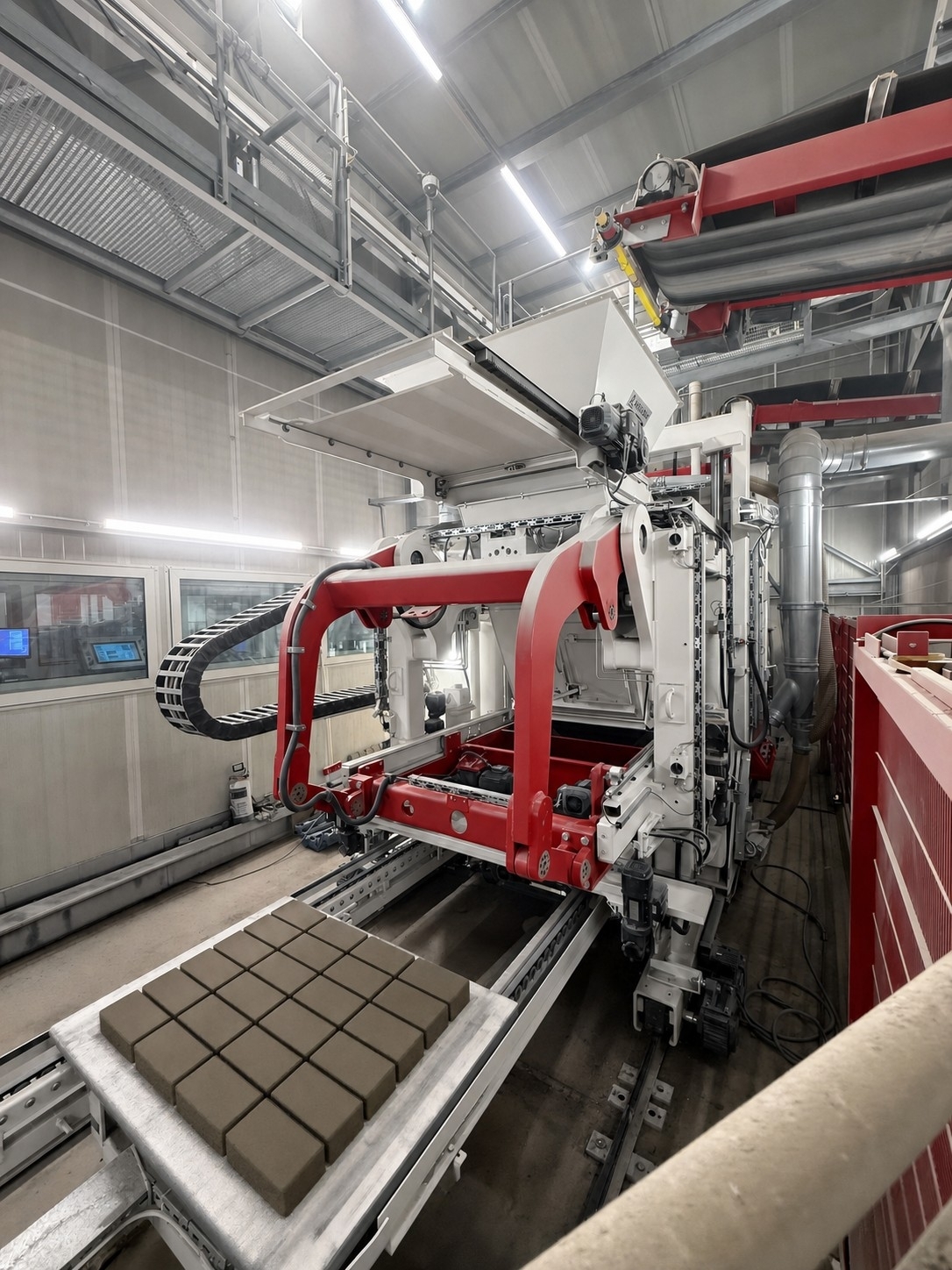 Figure: Hess Group
 Figure: Hess Group
 Figure: Hess Group
 Figure: Hess Group
 Figure: Hess Group
 Figure: Hess Group
 Figure: CureTec („AI Generated“/„KI-generiert“)
 Figure: CureTec
 Figure: CureTec
 Figure: CureTec
With the renovation of its concrete block plant in Tuusula, Rudus has completed one of the largest production investments in the company’s history. Thanks to a new high-performance system, production capacity has nearly doubled. CureTec was responsible for the entire curing technology as well as the enclosure for the new Hess press line – acting as a turnkey partner in close coordination with equipment manufacturer Hess and operator Rudus.
With the renovation of its concrete block plant in Tuusula, Finland, Rudus – part of the CRH Group – has completed one of the largest production investments in the company’s history. Two old production lines were replaced by a new high-performance line, nearly doubling production capacity. CureTec Energietechnik GmbH & Co. KG, based in Vrees, Lower Saxony, was responsible for the complete curing technology as well as the soundproofing and safety-related enclosure of the new Hess machine – acting as a turnkey partner in close coordination with plant manufacturer Hess and operator Rudus.
The investment decision was made in late 2024 at the parent company CRH. As early as September 2025, the two old production lines at the Ristikiventie site in Tuusula were shut down, and the new plant began operations on schedule in April 2026. To ensure supply to the greater Helsinki area during the transition phase, Rudus had deliberately built up inventory in the summer of 2025 and additionally drew on supplies from the plants in Tampere and Orimattila. The first shipments from the new line took place in May 2026. Since then, the modernized plant has been regarded as one of the most advanced, safe and efficient production facilities for concrete pavers and palisade products in Northern Europe.
New concrete goods plant integrated into existing production building
One of the challenges of this project was integrating the new production line into an existing building, which still housed the existing concrete production line at the time of planning. To ensure maximum planning reliability early in the project, the 3D scan data of the building created by Rudus was merged with the 3D design data for the new Hess plant. Based on this, a comprehensive collision analysis was performed, and the integration of all plant components was planned in detail.
The available space posed significant requirements for the plant design. Despite the limited space, all components of the new production facility had to be integrated into the existing building. Structural modifications were required, particularly for tall plant components such as the elevator, lowerator finger car and cuber, necessaritating the raising of the roof in these areas.
In addition, the existing hall columns had to be incorporated into the new plant design, as they had to be retained for structural reasons. This required precise coordination of all machinery and material-handling components in order to make optimal use of the available installation space while complying with current safety requirements. Only through meticulous planning of all plant areas could safe and efficient plant operation be ensured.
The close, collaborative partnership between Rudus and Hess proved to be a key factor in the project’s success throughout the entire project period. Thanks to the continuous exchange between the two project teams, technical challenges were identified early on and resolved jointly, laying the foundation for the successful implementation of the plant at the Tuusula site.
RH 2000-4 MVA: The Central Element
At the heart of the production plant is the RH 2000-4 MVA, which is designed for the cost-effective production of a wide range of concrete block products. Thanks to the machine’s extensive equipment, a wide variety of product requirements can be met flexibly and with a high degree of process reliability.
The machine’s design is based on a machine frame with exceptional torsional rigidity, constructed from solid steel components. Both the upper and lower frame sections are designed to withstand the consistently high loads generated by the vibration system during the compaction process. This ensures a high level of operational reliability and a long operation life for the machine. To ensure precise adherence to product heights, the machine is equipped with four tamper head cylinders. This system enables even force distribution – particularly for large-format products – and supports the production of products with consistently high dimensional accuracy.
The designation “MVA” indicates that the machine is equipped with high-performance MLC control technology. Compared to conventional SPS solutions, this enables significantly faster response times and much more precise production. The position data for the tamper head, the filler boxes and the mold lifting are continuously recorded and processed in real time. Based on this data, the system controls the hydraulic movements of the individual components. This enables dynamic and overlapping motion sequences that positively impact both productivity and the wear and tear on machine components. At the same time, cycle times can be reduced, while maintenance requirements are minimized by eliminating the need for additional synchronization and tamper head braking systems.
Hess’s proven Variotronic vibration system is used to compact the products. The system is equipped with four independently driven vibrator segments, each powered by a servo drive. This allows the vibration force to be optimally adjusted to the specific product requirements. The stepless adjustment of the phase angles between the individual unbalanced drives allows for precise control of the compaction energy. At the same time, the frequencies optimal for each production step can be controlled. This creates the conditions for even compaction and high product quality across the entire product range.
To extend service life, the bearings of the vibration units are oil-bath lubricated. This design reduces maintenance requirements, minimizes downtime, and contributes to high plant availability. The face mix filler box also features the patented Hess face mix planing roller. It ensures even distribution of the face concrete across the entire mold surface and reliably prevents the material from being dislodged during the filling process. This ensures consistent face mix quality and an even surface appearance of the produced concrete blocks.
Automatic fast mold change system
To minimize downtime, the system is equipped with an automatic fast mold change system. This allows a complete mold change to be carried out in about five minutes. The entire process requires only one operator and, at the same time, increases workplace safety, as manual positioning tasks of the molds are largely eliminated. A key advantage of the system is that the new mold can be positioned on the electrically powered mold-change cart while production is still running. Preparation for the next production order thus takes place in parallel with ongoing operations, thereby avoiding interruptions.
During the mold change process, the used mold is placed on a production board, unlocked, and then ejected from the machine area through the lifted face mix part. At the same time, the new mold is transported to the center of the machine via the mold change cart. Positioning is fully automatic and performed with high repeatability before the mold is securely locked into the machine. To further accelerate the changeover process, the face mix and coarse mix part are lifted by fast lifting cylinders. This creates the necessary clearance for the molds’ transport movements. The interaction of the individual components enables a fast and safe mold change and thus contributes significantly to improving production planning.
Wet Side/Transfer to the Drying Chamber
After demolding, the products are transferred from the RH-2000 to the subsequent conveyors on the wet side. Heavy-duty V-belt conveyors are used up to the point where the molds are discharged, in order to handle the heavy weight of the molds even during mold changes. Immediately following the production process, an automatic height inspection of the products is performed using a laser measurement system. This allows deviations to be detected early and ensures compliance with the specified product height.
Further along the line, there is a separate quality control station. It is positioned at a 90 degree angle to the conveyor direction, and the lifting station allows individual production boards to be discharged for detailed quality control. The key advantage of this design is that products can be inspected without disrupting the production process on the wet side. Once the inspection is complete, the production board is automatically fed back into the system at the push of a button.
Next, a double board is formed so that, if necessary, two production boards can be transported through the three-station washing device at the same time. The rinsing system is designed as a three-stage system. In the first step, the surface of the products is washed out by oscillating high-pressure nozzle strips. This is followed in the second step by a final rinse of the surface using a surge tank. In the final step, excess water is blown off to reliably prevent dripping during subsequent curing in the chamber. A dump station is also located before the transfer to the elevator. This is used in particular when emptying the machine to dispose of production residues or non-conforming products in a controlled manner.
The production boards are then transferred, along with the freshly produced concrete block products, to the elevator and stacked vertically for further transport to the curing chamber.
Curing Chamber with 30 storeys
The curing chamber was designed to optimize the use of available space, with a storey distance of just 200 mm, a board width of 1,520 mm, and 30 storeys. When producing low products, this design allows for dense stacking and thus maximizes the use of available space. A key prerequisite for this is the design of the finger car. Thanks to the slim design of the forks, which run alongside the products, the production area will not be significantly affected. This provides a large area for production.
The finger car is equipped with a turning device, enabling it to serve both sides of the system. This feature was necessary because the curing racks are located on the opposite side of the system. This system design allowed for optimal use of the available installation space within the existing production hall. Once the curing process is complete, the finger car retrieves the production boards from the racks and transfers them to the lowerators. The system has two lowerators, ensuring reliable operation of the entire system, because the second lowerator can be used as a buffer.
In addition, both lowerators can alternately transfer the products to the subsequent conveyor line. This feature offers a decisive advantage, particularly in the production of Colormix products, since different product batches can be specifically blended together, thereby achieving a varied appearance in the resulting stone packages.
Dry side & stone squeezer
The two lowerators are connected to the dry side’s latch conveyor via a bypass. After being transferred from the lowerators, the products first reach an inspection and quality control station. Here, individual products can be specifically inspected, and defective stones can be replaced as needed before they proceed through the rest of the process.
The products are then pushed together layer by layer by a stone squeezer. The stone squeezer is fully equipped with electric drives and therefore requires no hydraulic components in this area. In addition to precise and dynamic movements, this eliminates the risk of hydraulic oil leaks.
Packaging
Electric drive technology is also consistently used in the packaging process. Both the carriage and the gripper of the cuber are equipped with electric carriage cart. This enables fast, precise, and overlapping motion sequences, resulting in high dynamics and faster cycle times. The Servo 700-2 cuber transfers the finished product layers from the dry side and places them layer by layer onto the provided transport pallet. This process is repeated until the specified package or stack height is reached on the packaging line.
The stacked products then reach the wrapper and continue to the unloading area. At the end of the packaging line, the stacked products are unloaded outside the facility using a forklift. The products can then either be stored directly or prepared for shipment to the customer.
Board Conveyor
After the stone layers are removed by the cuber, the empty production pallets are fed into the board transport system. As part of the circulation process, the boards are first cleaned of any concrete residue by a board brush, then turned over by a board turner and transferred to the board stacking device. The formed board stacks are then picked up by the board buffer finger car. It is equipped with a turning device, which enables the pallets to be transferred to the pallet buffer rack on the opposite side.
With a total capacity of 3,150 production boards, the board buffer rack provides sufficient reserve capacity to compensate for production fluctuations and ensure continuous plant operation. The board buffer rack also plays an important role in the production of higher products. In this case, every second production board can be specifically taken out of the system, thereby ensuring that every second shelf in the curing chamber is occupied.
Curetec supplied the curing system and plant infrastructure
With the renovation of its concrete products plant in Tuusula, Rudus – part of the CRH Group – has completed one of the largest production investments in the company’s history. Two aging production lines were replaced by a new high-performance facility, nearly doubling production capacity. CureTec Energietechnik GmbH & Co. KG, based in Vrees, Lower Saxony, was responsible for the complete curing technology as well as the soundproofing and safety-related enclosure of the new Hess press line – acting as a turnkey partner in close coordination with plant manufacturer Hess and operator Rudus.
The investment decision was made in late 2024 at the parent company CRH. As early as September 2025, the two old production lines at the Ristikiventie site in Tuusula were shut down, and the new plant began operations as scheduled in April 2026. To ensure supply to the greater Helsinki area during the transition phase, Rudus had deliberately built up inventory in the summer of 2025 and additionally drew on supplies from the plants in Tampere and Orimattila. The first shipments from the new line took place in May 2026. Since then, the modernized plant has been regarded as one of the most advanced and efficient production facilities for concrete pavers and palisade products in Northern Europe.
CureTec as a turnkey partner
For the process engineering aspects of the renovation – the curing of concrete products as well as the structural and safety-related enclosure of the new Hess press line – Rudus commissioned CureTec Energietechnik to handle the complete planning, manufacturing, delivery (DAP Tuusula), and installation supervision. The project comprised two closely interlinked components: the curing rack and climate control system for the curing chambers, and the soundproofing and control room complex surrounding the new press. Both assemblies were supplied by CureTec as a comprehensive, end-to-end solution from a single source – including structural analysis, steel construction, HVAC, control systems, and installation.
The centerpiece: the curing rack system
The centerpiece of the delivery is a hot-dip galvanized curing rack system with 30 levels, divided into 15 chambers, each with five rows. With 4,350 installed and 3,990 usable pallet spaces (pallet size 1,520 × 1,100 mm, load capacity up to 780 kg per pallet), it forms the logistical backbone of the new production line. The main racking system is supplemented by an additional buffer racking system for 3,150 pallets.
The consistent hot-dip galvanizing process provides lasting protection for the steel structure against corrosion, which inevitably occurs due to constant fluctuations in temperature and humidity inside the curing chambers – in CureTec’s view, this is the most cost-effective solution compared to retroactive or partial corrosion protection. Sandwich panels, 80 mm thick, seal the chambers off from the outside; electrically heated edges at the entry and exit points prevent condensation, and high-temperature viewing windows and a separate maintenance access point with a safety ladder round out the features.
Climate control based on the CureComplete principle
The CureComplete system from CureTec ensures a precisely reproducible curing environment: Temperature and humidity can be set in the large-volume chamber between 30 and 35 °C and 65 and 85% relative humidity, respectively, and maintained with a guaranteed uniformity of ±1.5 °C and ±5%, respectively. Several hot-air generators with a total output of up to 225 kW/h – supplemented by a backup unit providing 100 kW/h – supply a galvanized air distribution system, while high-pressure humidification and water treatment ensure the target humidity is maintained.
The entire system is controlled via a Siemens S7 controller with a color touchscreen and remote maintenance connectivity – user-friendly for operating personnel and, at the same time, robust enough to reliably cure future product variants and larger formats.
Soundproofing and Safety for the Hess Press
A second, equally challenging project involved the new Hess RH 2000-4 MVA brick-making plant. For this project, CureTec designed and constructed a complete steel-framed soundproof enclosure with external dimensions of approximately 11,800 × 6,300 × 7,900 mm. Approximately 350 m² of acoustic sandwich panels with a perforated inner surface, steel that is galvanized and painted on both sides, and 100 mm of insulation thickness have been proven to reduce the press’s noise level to a guaranteed Rw value of 34 dB – a value that CureTec has also contractually guaranteed.
Particularly noteworthy is the integration of an indoor crane directly into the soundproofing structure: Reinforced columns and crane runway rails support a bridge crane with a load capacity of up to 3,000 kg, eliminating the need for a separate crane runway structure outside the cabin. A horizontal support beam was deliberately designed so that the cabin can be opened 7.00 m on one side in the future without having to modify the crane runway – an example of forward-thinking, expandable plant design. Circumferential maintenance platforms on both sides and between the press sections, galvanized access stairs for the wet and dry sides, and a separate hydraulic room round out the design.
The control room as a second pillar
Adjacent to the soundproof booth, CureTec constructed a two-story control room building with exterior dimensions of approximately 12,000 × 3,300 × 6,700 mm. The ground floor houses the actual control room, while the upper floor contains the control cabinets, separated by a mezzanine level that accommodates all the cabling. Galvanized staircases connect the control room to the maintenance platforms at the press, allowing operating and maintenance personnel to move quickly between the control room and the press. Access staircases and walkways to the wet and dry sides of the line – all hot-dip galvanized and equipped with handrails – complete the infrastructure.
Close coordination with Hess and Rudus
A project of this magnitude can only succeed through close collaboration among all parties involved. CureTec coordinated the steel structure and crane runway geometry of the soundproof enclosure directly with Hess’s machine specifications to house the press without compromising accessibility or future expandability. In collaboration with Rudus, the installation schedule was coordinated so that the control room and soundproof enclosure could be installed during the same time window as the curing rack system – aligned with the tight production shutdown window between fall 2025 and spring 2026, during which Rudus required only small quantities of landscaping products anyway. This synchronization minimized downtime and ensured that the complex overall facility could go into operation on schedule and without the various trades interfering with one another.
The Benefits for Rudus
For Rudus, CureTec’s turnkey solution pays off in several ways: The nearly doubled curing capacity and the ability to produce larger block formats directly support Rudus’ stated goals of shorter delivery times and a broader product portfolio in the greater Helsinki area. At the same time, the precisely controllable climate control system improves the product quality of high-end multicolor and exposed aggregate concrete products. The guaranteed Rw value of 34 dB and the well-designed crane integration noticeably enhance workplace safety on the new press line, while the forward-thinking design of the expansion opening in the soundproof enclosure keeps all options open for Rudus regarding future capacity increases without having to alter existing crane runways. Last but not least, consolidating racking systems, climate control, soundproofing, and the control room with a single supplier significantly reduces the interface risks of an already complex renovation project.
With the project in Tuusula, CureTec Energietechnik underscores its role as a turnkey partner for concrete product manufacturers – a role that extends far beyond traditional curing technology: from climate control and steel construction to sound insulation, crane integration, and control rooms, the Vrees-based company delivers complete, coordinated plant complexes from a single source. For Rudus, the modernized plant in Tuusula is thus not only the most advanced production facility of its kind in Northern Europe, but also proof of how close cooperation between the operator, machine manufacturer, and plant engineer leads a large-scale project to success on schedule and without a hitch.
Talahat Akcay, project manager and authorized signatory at CureTec Energietechnik, concludes: “Projects like Tuusula demonstrate what is possible when operators, machine manufacturers, and plant builders plan as a team from the very beginning. We didn’t just deliver a curing system – we provided a complete, future-proof environment for Rudus’s new press line.”
CONTACT
Hess Group
Freier-Grund-Str. 123
57299 Burbach/Germany
+49 2736 4976-6689
CureTec Energietechnik GmbH & Co. KG
Lehmkuhlen 13
49757 Vrees/Germany
+49 4479 9390-600