


From stranded seaweed to a controlled
secondary raw material for concrete
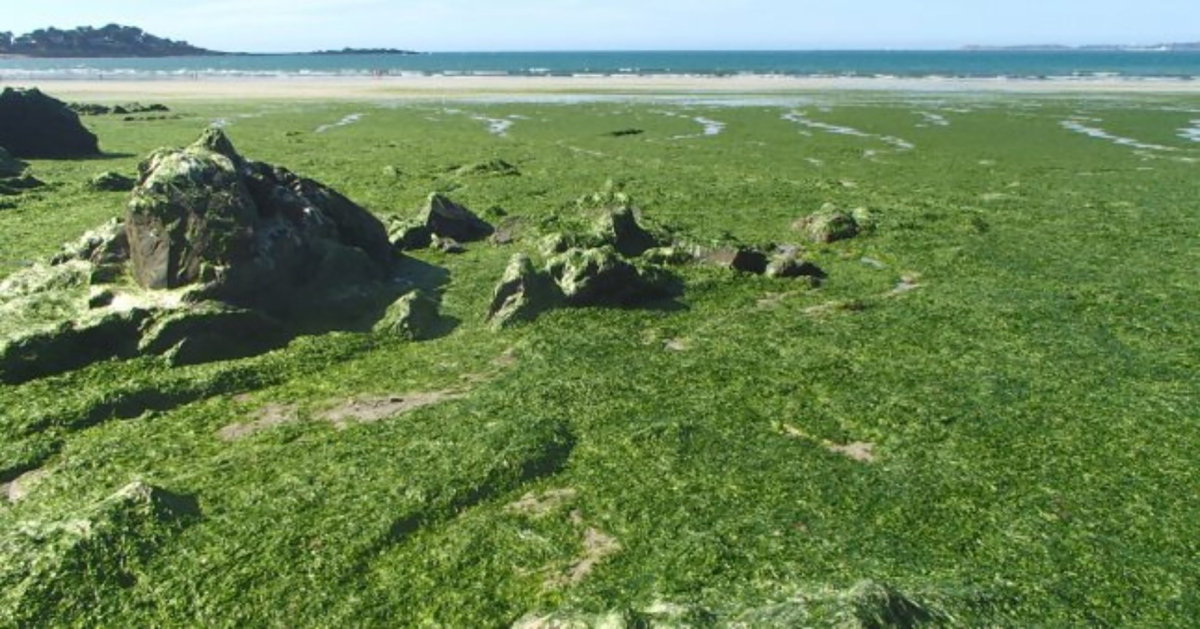 Figure: David Terradot-Piot
 Figure: David Terradot-Piot
 Figure: David Terradot-Piot
 Figure: David Terradot-Piot
 Figure: David Terradot-Piot
 Figure: UNICEM Campus
Recurring strandings of green algae and pelagic Sargassum, generate wet, saline and chemically variable biomass. This project does not assume that raw seaweed can replace cement. It asks whether a controlled fraction, after washing, drying, grinding, characterisation and, where justified, thermal transformation, could become a reproducible low-dose constituent for concrete.
Recurring strandings of green algae on the French Atlantic and Channel coasts, and pelagic Sargassum in the French Caribbean, generate wet, saline and chemically variable biomass. This project does not assume that raw seaweed can replace cement. It asks whether a controlled fraction, after washing, drying, grinding, characterisation and, where justified, thermal transformation, could become a reproducible low-dose constituent for concrete.
1 Seaweed is not a concrete constituent until it is qualified
For coastal authorities, stranded algae are first a collection and treatment problem. For concrete technology, a biological material must be converted into a feedstock with known moisture, particle size, density, salt content and contaminant profile before it can be dosed reproducibly. Ulva collected in Brittany or Normandy can vary with season, location and time spent stranded; Sargassum can vary with oceanic origin, coastal retention, sand contamination and degradation. Each batch therefore has to be treated as a material lot with a recorded collection site, date, condition and preparation history.
Concrete formulation works with measurable properties, not with the generic term ‚seaweed‘: batch variability can change effective water content, paste volume, workability and admixture demand. The first objective is therefore not performance improvement, but reduction of variability to a level that can be measured and controlled.
2 Pretreatment: what every operation is intended to achieve
The first barrier is salinity. Sand, shells and foreign matter are removed, then the biomass is washed in controlled freshwater cycles. The aim is not cosmetic cleaning: soluble chlorides, sodium, potassium and other salts must be reduced because they can affect cement hydration, durability and, in reinforced concrete, corrosion risk. Conductivity of successive rinse waters is useful as a rapid process indicator, but the washed solid must still be analysed. Water-to-biomass ratio and number of cycles are recorded so that one prepared batch can be compared with another.
After draining, low-temperature drying stabilises the biomass and makes mass-based dosing meaningful. A starting condition around 60 °C for about 24 h, followed by drying to constant mass when required, is used as preparation rather than calcination, so the organic fraction remains present. The dried material is ground and sieved; an initial fraction below about 500 µm can be screened as a fine constituent. Density, bulk density, particle-size distribution, water absorption, loss on ignition and elemental composition then become concrete-production parameters. The route also creates secondary streams: wash water is saline and may contain transferred contaminants, while drying and grinding consume energy. These outputs must be accounted for rather than presenting the cleaned solid alone as the environmental result.
3 What changes in the concrete mix?
A treated algal powder cannot be evaluated only by replacing a percentage of cement and measuring compressive strength. Its density may be far below that of a mineral filler, so the same mass can occupy a much larger volume. Its porosity and surface chemistry can absorb mixing water, while residual moisture can add unaccounted water. Dry mass, moisture correction, density and absorption therefore have to be known before the first formulation is interpreted.
The initial programme compares a reference concrete with low incorporation rates while keeping cement content, aggregate skeleton, water-to-binder ratio, mixing sequence and curing as constant as practicable. Fresh-state testing includes slump or flow, density, air content where available and workability retention. If slump falls, the cause must be separated: absorption, increased surface area, entrained air or chemical interaction can require different responses. Simply adding water would change the water-to-binder ratio and invalidate the mechanical comparison. Admixture adjustment belongs to later optimisation, after the untreated effect has been measured.
Hardened screening begins with compressive strength at several ages, followed by absorption, accessible porosity, shrinkage and durability indicators suited to the intended application. A small strength increase is not sufficient if porosity rises, workability becomes unstable or the material introduces an unacceptable contaminant pathway. In plant terms, the question is not only ‚does it reach strength?‘ but ‚can it be stored, dosed, mixed and reproduced without disturbing concrete quality control?‘^
4 Chlorides and arsenic are decision gates
Residual chlorides are particularly important for reinforced concrete. The project therefore treats chloride content as an acceptance parameter for the prepared biomass, not merely as a property of the original seaweed. If reproducible desalination requires excessive freshwater or still leaves an unsuitable chloride level, the reinforced-concrete route has to be rejected or redirected toward another application.
Sargassum adds a second safety gate: arsenic. Heating must never be described as automatic decontamination. Depending on temperature and process conditions, arsenic can remain in the bottom residue, concentrate in fine ash or transfer to condensates and gas-treatment streams. The programme therefore follows a mass-balance logic across raw biomass, wash water, dried material and any thermally transformed product. The final question is mobility in service: leaching has to be assessed on the treated material and, when relevant, on the hardened cementitious matrix. Mechanical performance cannot compensate for unresolved arsenic mobility.
5 Thermal treatment is an alternative route, not the starting point
If washed and dried biomass remains too organic, absorbent or variable for direct use, thermal transformation can be tested. Thermogravimetric analysis should first identify water loss, organic decomposition and stabilisation of the mineral fraction. An exploratory calcination window around 500-700 °C can then be compared with lower-oxygen pyrolysis when a biochar-type material is of interest. The product still has to be characterised for mineralogy, elemental composition, loss on ignition, density, fineness, absorption and specific surface where available. Thermal treatment only adds value if the product is more stable and reproducible and the energy and contaminant balance remain acceptable.
6 What the two prospective curves actually mean
The two curves supplied with the article are working hypotheses from the experimental protocol, not measured results and not performance claims. For 28-day compressive strength, the reference is indexed at 100. The Ulva hypothesis rises modestly to 102, 105 and 104 at 1, 2 and 3% incorporation, before falling to 101, 96 and 90 at 4, 5 and 6%; the Sargassum hypothesis is deliberately more conservative at 101, 103, 102, 98, 92 and 85. The possible low-dose optimum represents a filler/packing or nucleation effect that could densify the paste locally. The later decline represents the opposite mechanisms becoming dominant: higher water demand, residual organics or salts, weaker particle-paste interfaces and additional porosity.
The workability curve starts from a theoretical reference slump of 180 mm. The Ulva series falls to 174, 166, 154, 138, 120 and 100 mm from 1 to 6%; the Sargassum series to 170, 158, 142, 122, 100 and 78 mm. This is not a prediction of a future commercial mix; it is a conservative hypothesis that forces the programme to examine whether absorption and surface area progressively consume free water. Together, both curves define where measurements are most informative: low dosages are examined closely because any usable window is expected there, while higher dosages act as stress cases. The important result will not be one point above the reference, but whether repeated batches reproduce the same behaviour with acceptable variability.
7 From laboratory result to a plant acceptance rule
A laboratory powder becomes industrially relevant only when incoming quality can be specified. A future specification would need limits or declared ranges for moisture, chloride content, particle-size distribution, density or bulk density, absorption and, for Sargassum, contaminants such as arsenic. Sampling frequency is equally important because one analysis cannot represent a variable coastal biomass stream. At the batching plant, storage and dosing rules would then be required.
Hygroscopic material can regain moisture after drying; a low-density powder may need volumetric interpretation; a highly absorbent fraction may require preconditioning or a defined water correction. The producer must know which parameter triggers acceptance, adjustment or rejection. This is the point at which the project moves from waste valorisation to concrete quality control. Stop/go criteria therefore include excess residual chloride, unstable setting, unacceptable slump loss, poor strength retention, high porosity, contaminant release or an unreasonable processing-energy balance. A negative result is useful if it prevents an unsuitable material from reaching production.
8 Industrial and environmental logic must remain local
Transporting wet algae over long distances means transporting mostly water. A plausible chain therefore combines coastal collection with local sorting and draining, followed by controlled washing, stabilisation and size reduction before delivery to a nearby materials facility. Mechanical dewatering, ventilated or solar-assisted drying and available waste heat should be compared where scale permits.
The balance must include freshwater for desalination, drying energy, grinding, thermal processing if used, wash-water treatment and rejected fractions. Circularity is demonstrated only if the complete route avoids shifting the burden from the beach to another process stream.
9 Conclusion
The Green Challenge is not simply to put algae into concrete. It is to transform a wet, saline and variable coastal biomass into a traceable secondary material whose behaviour can be predicted at the mixer and controlled through normal quality procedures. Ulva and Sargassum are likely to require different preparation routes, and the most credible outcome may be a low-dose filler, transformed fine fraction or component of a composite aggregate rather than major cement replacement. The value of the programme lies in defining the usable window, the rejection criteria and the controls needed before any industrial trial.