

Construction Systems or Flexibility? The Formwork Strategy Makes the Difference


Standardisation ensures efficient processes, but changing element geometries and smaller batch sizes call for adaptable production concepts. The right formwork strategy for a precast concrete plant therefore depends on its product range, capacity utilisation and market requirements. Modular solutions demonstrate how product variety and investment risks can be kept under control.
A construction system brings together precast elements, connection methods and production processes within a single, integrated concept. Standardised components and workflows improve quality, productivity and cost efficiency. When large numbers of identical or similar elements are produced, this is often the most economical solution.
At the same time, fluctuating demand, smaller batch sizes and an increasing variety of products require greater flexibility. Today, many precast concrete plants operate somewhere between serial production and project-based manufacturing. New market segments are also emerging, although their long-term potential is often difficult to predict. The key question is how economically production can respond to changes in products, batch sizes or market requirements.
Formwork plays a central role in this. It not only defines the geometry of the precast element but also determines the range of possible variations, set-up effort and scope for future expansion. The goal is therefore not maximum flexibility, but rather providing exactly the level of adaptability that is actually needed.
Standardising the formwork system instead of every individual component
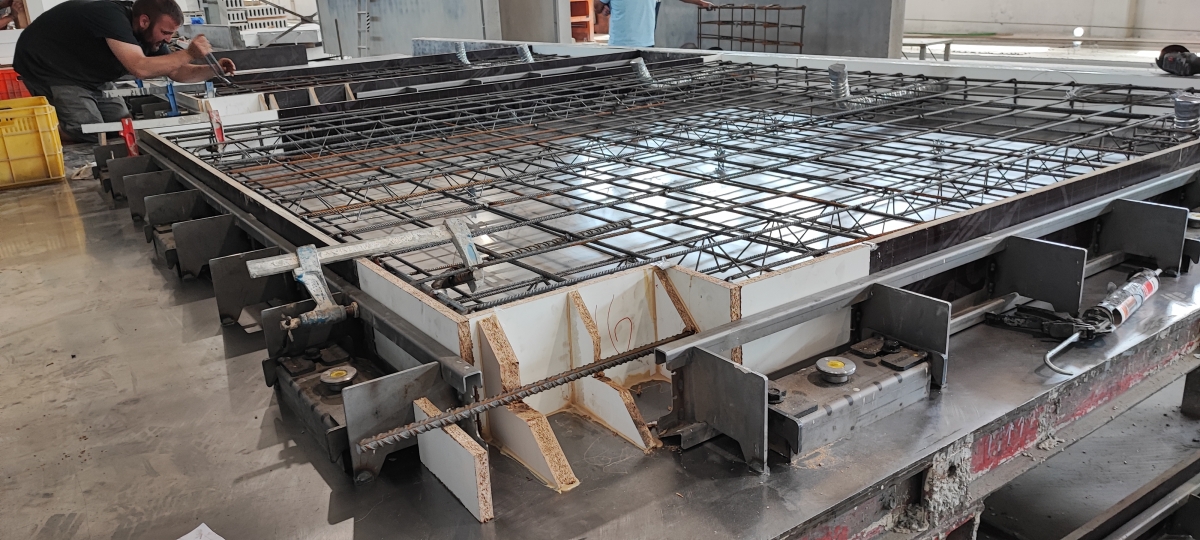
Modular formwork systems shift the focus of standardisation to the production equipment. Instead of keeping separate formwork units for every variation, standardised components are recombined as required. This is the principle behind Ratec‘s modular MST formwork system and Easy Form system. With MST, base profile and formwork elements can be configured, connected and extended to accommodate different lengths and heights. Easy Form uses different rib configurations to cover wall thicknesses ranging from 45 to 400 millimetres.
The more variants that can be produced using the same core components, the lower the project-specific investment share becomes. Once a project is completed, the formwork remains available for future use.
Controlled rather than unlimited variety
In modular construction, achieving the right balance between standardisation and flexibility is particularly important. Moulds for volumetric precast elements are often designed as a fixed structure. Where adjustable features are incorporated, they can affect dimensional accuracy, ease of operation, occupational safety and productivity. For this reason, project requirements should ideally be defined at an early stage. These may include the range of element dimensions, modular dimensions, wall thicknesses, openings and recesses, batch sizes and acceptable changeover times.
The potential scope is illustrated by 3D moulds for transformer stations and cable basements. For a customer in Central Europe, Ratec has developed several adjustable moulds, each capable of producing more than 1,000 different concrete elements. For example, the length can be adjusted between three and eight metres in increments of 200 millimetres. Several widths and/or heights can also be accommodated, together with an additional grid for internal walls. The key is that this variety is achieved within a clearly defined system and remains manageable in production.
Growing alongside the market
When entering a new market, future capacity utilisation is often uncertain. Investing in formwork designed for maximum capacity from the outset can tie up capital before sufficient orders are secured. A scalable approach is often the more sensible option.
One example is Ratec‘s modular casting table, initially developed for customers in the Asian market. The casting surface consists of bolted table segments that can be combined both lengthwise and crosswise. Manufacturers can start with just a few segments and expand the system at a later stage.
The same principle was applied to a compact single-pocket battery mould. Rather than investing immediately in a large-scale battery system for vertical production, an initial solution with just one pocket was developed. This enabled a new product line to be launched quickly and with a significantly lower capital investment.
This approach allows investment and production capacity to grow in line with actual demand – a clear advantage for manufacturers seeking a rapid return on investment.
Balancing efficiency and flexibility
The more complex a product range becomes, the more important it is to integrate formwork considerations into product and production planning at an early stage. Only by considering element geometry, reinforcement, cast-in components, the concreting process and handling requirements together is it possible to assess which solution will be economically viable. This transforms the formwork manufacturer from a mere supplier into a development partner.
For large production runs of identical elements, purpose-designed formwork may be the most economical solution. For smaller batches and changing geometries, a modular formwork system offers greater flexibility, while expandable solutions can support manufacturers entering new markets. The objective is a production system that is standardised enough to operate efficiently, yet flexible enough to respond to future market demands. Ultimately, formwork strategy determines whether product variety becomes a cost driver or a competitive advantage.