

Successful product with new features

The new sensor Hydro-Mix
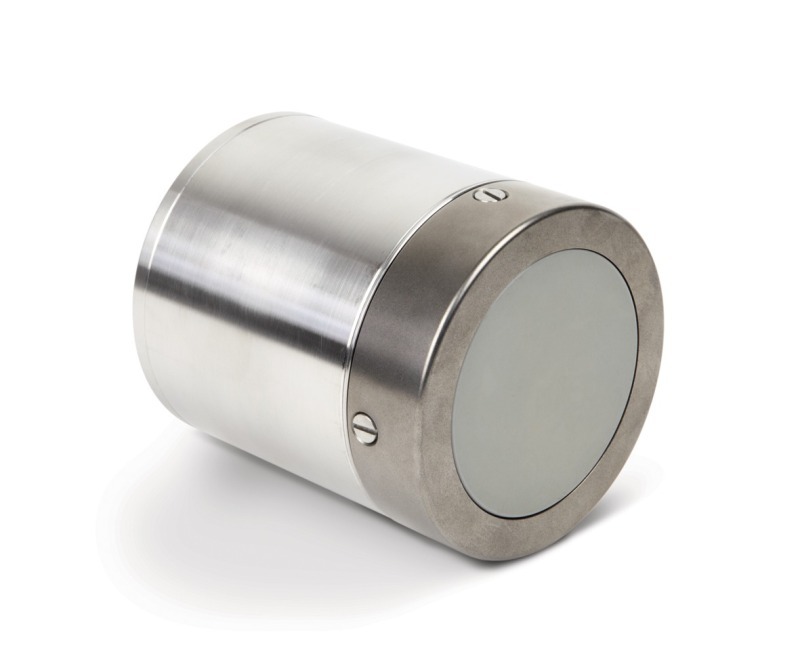
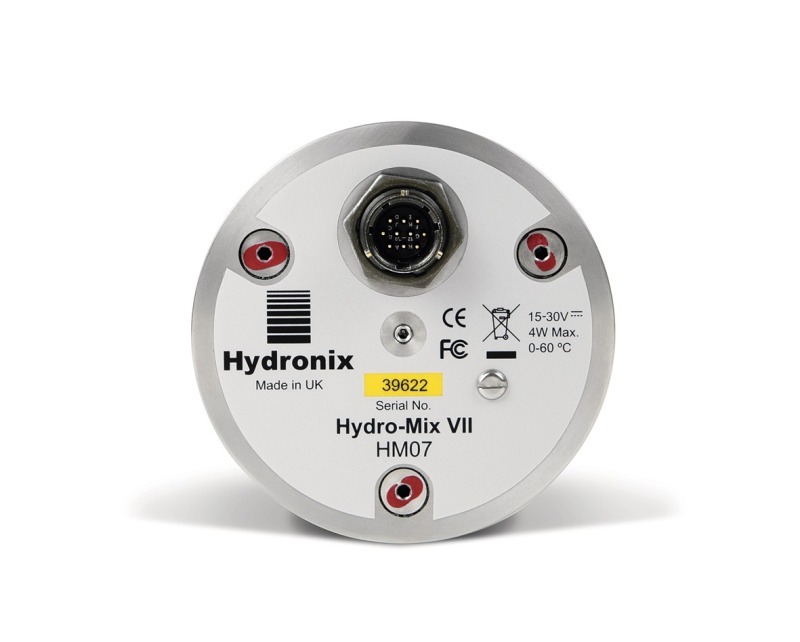
Hydronix is proud to announce the release of the next generation of microwave sensors for mixers and screw conveyors, the Hydro-Mix VII. It will be officially launched at the World of Concrete exhibition in Las Vegas on 2nd – 5th February 2010, and will also be on display in Europe at Bauma, Munich in April.

Building on the success of the Hydro-Mix VI, the new generation sensor features the following four aspects:


New Signal Processing Features

Filtering has always been useful to minimise the noise in the signal that is generated by the application itself. For example, the sensor may first see material, next a passing metal blade, then an air void. Filtering works on the basis that the sensor knows that the majority of what it ‘sees’ is material and it filters out the signals that are outside of the ‘normal’ range. Where this becomes increasingly complex is in cases where it is more difficult to identify what is ‘normal’. An example of this is an air void that can be created (seen as a vortex) in a very fast planetary mixer working with a highly viscous mix, particularly if the mixer is only one third full. In some cases the vortex (of air) may cover a significant proportion of the mixer floor.

The new Hydro-Mix VII has been enhanced over the previous model with the addition of advanced Digital Signal Processing (DSP) filters. They have been used for many years in industry, and Hydronix have found these filters when combined with existing filtering parameters to be beneficial to getting a high speed accurate response. The DSP maximises the attenuation of the noise in the signal while preserving all the speed of response of the sensor to the changes of moisture in the material. The DSP filters may be configured to operate with or without the existing filtering parameters giving a new dimension to controlling the measurement signal. For many applications such additional control will be unnecessary but for someone installing a sensor in a more difficult application, it gives them peace of mind to know that they now have additional tools to ensure that the sensor can be easily configured to output the smoothest and fastest responding signal possible.

The most advanced development in the Hydro-Mix sensor has not however been in the area of digital processing, it has been a fundamental change to the measurement technique used to obtain moisture data from the material.

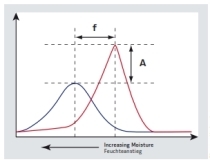
As material with different moisture levels passes over an analogue sensor, it measures a combination of a frequency shift and a change in amplitude of an attenuated microwave signal. Previously, the Hydronix range of sensors have measured the frequency shift with digital accuracy giving them their unique measurement characteristics of extended linearity over a very wide moisture range.However, the new Hydro-Mix VII now has the added ability to accurately measure the amplitude of the microwave signal using a digital technique. Both the frequency and amplitude are measured independently of one another, unlike an analogue sensor that only ‘sees’ the combined signal. These two totally separate digital measurements are then combined using precise mathematical formulae and can be used to calculate various properties of the material.

By creating such a basis on which to perform signal processing, the user has a greater degree of choice when configuring a sensor. In real terms, this means that the user now has a greater degree of choice when configuring a sensor. The Hydro-Mix VII offers a choice of 3 operating modes, the original ‘standard’ mode, which will be suitable for nearly all applications, and two further modes that may be selected to further improve either sensitivity or stability, dependant on the characteristic of the material and application. In these and other scenarios having improved digital filtering operating upon new measurement modes will be an obvious advantage.


Improved Temperature Stability

Hydronix has also improved the temperature stability in the latest version of the Hydro-Mix.  All Hydro-Mix VII sensors are monitored during production so that each sensor is given a unique individual temperature correction.  This is embedded in the software to give the highest possible level of temperature stability in a microwave sensor. 


Redesigned Ceramic Faceplate

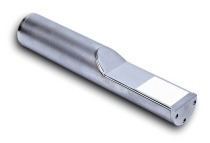
From the perspective of the end user, and to improve the already excellent cost effectiveness of the sensor, the Hydro-Mix VII has been redesigned to include the strongest ever ceramic faceplate used in a Hydronix sensor. This improved design also allows for much easier and quicker changing of the ceramic in the unlikely event of it being damaged.


Two Analogue Outputs

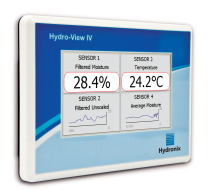
A second analogue output has been added making it possible for the sensor to output two different readings simultaneously.


Conclusion

Hydronix developed the first microwave sensors over 28 years ago, and then continued to break new ground with the introduction of the digital measurement technique. This technique is used in the current generation of sensors. These sensors have become the dominant ‘industry standard’ with tens of thousands of installations worldwide. ˘


Advertisement


subscription/test subscription

You want to order a subscription/test subscription?
If so you are right here!  Here to order