

Sustainable lightweight concrete with geopolymers

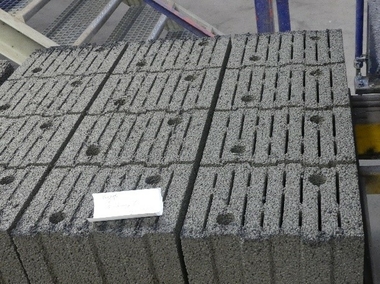
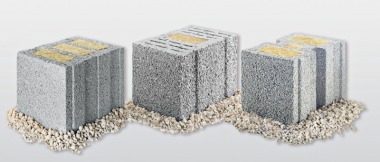
Lightweight concrete already now stands out against other building materials due to numerous specific advantages. These include, for one thing, its low bulk density and, associated therewith, its good thermal insulation properties. For another thing, it exhibits a very good eco-balance due to the low primary energy consumption and the high degree of recyclability. For the production of masonry blocks made of lightweight concrete, natural lightweight aggregates such as pumice are primarily used in the Neuwied Basin. As binders, the industry opts for cement with reduced clinker contents and natural pozzolanic grinding additives (trass cement), among others.
Objective of a current ZIM joint research project “EcoLight” is to further improve the ecological and technological properties of masonry blocks made of lightweight concrete using alternative CO2-optimized binders from local resources. The project is funded by the Federal Ministry for Economic Affairs and Energy (BMWE) on the basis of a resolution passed by the German Parliament. Scientific project sponsor is Koblenz University of Applied Sciences. Industry partners are Gebr. Zieglowski GmbH & Co. KG (Kruft) and Brameshuber + Uebachs Ingenieure GmbH (Aachen).
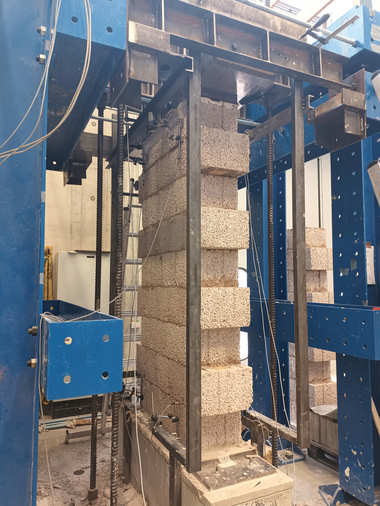
The paper reports on the current status of the individual research objectives. First of all, this includes the chemical activation of the natural pozzolana pumice and trass as essential constituent of the new alkali-activated binder (geopolymer) and the new lightweight concrete mix designs. Following the development of binder and mix design as well as the characterization of lightweight concrete properties, the perforation patterns are optimized from a building physics and mechanical point of view. The development of an innovative, automated production process and a method for processing the materials allows for a repeatable and efficient production of the new cement-free masonry blocks made of lightweight concrete.