


It’s all about speed – Environmental and economic aspects of state-of-the-art structural repair

Germany is facing a structural bridge crisis. An analysis of the structural data published by the Federal Highway and Transport Research Institute (Bundesanstalt für Strassenwesen; BASt) revealed that about 40% of all highway bridges were built in the 1960s and 1970s – primarily as prestressed reinforced concrete structures exceeding 100 meters in length. After 50 to 65 years of service, these bridges are currently entering a phase of exponentially accelerated deterioration.
At the same time, there is a significant redundancy deficit since about 31% of all bridges were designed as single structures with no parallel sections. This is why their failure inevitably leads to complete closure, causing high follow-up costs for the entire economy. It is not individual cases of damage that jeopardize the functional safety of transport infrastructure, but the simultaneous ageing of an entire generation of structures. This is why time is of the essence: It is not the construction method or the initial investment as such that determines overall environmental and economic impact, but the duration of closures and diversions. Traffic-related diversions and congestion generate significant carbon emissions and losses amounting to billions.
The required paradigm shift should thus move from isolated cost analyses towards a holistic life cycle assessment that considers construction time, resource efficiency, and availability as factors of equal significance.
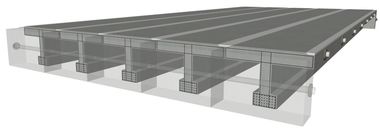
This is where materials with nonmetallic reinforcement such as carbon-reinforced concrete – a modern textile-reinforced high-performance composite – offer outstanding potential. Corrosion-resistant carbon-reinforced structures can be used to upgrade engineering structures quickly, permanently, and in a material-efficient manner. Using nonmetallic reinforcement for repair significantly shortens construction time while extending the service life of structures, which makes a major contribution to the environmental and economic sustainability of our infrastructure. However, effective life-extending measures must also be considered until structures can be repaired or newly built.