

From Formwork to Freeform: SPI Additive Manufacturing at Mangrove, USA


Concrete has earned its reputation as one of the most dependable building materials in the world. But when projects move beyond flat panels and simple geometries into curvature, deep texture, and expressive architectural forms; the challenge is rarely the concrete itself. Complex forms and liners are time-consuming to design, expensive to fabricate, difficult to store, and often hard to justify when quantities are limited, or designs evolve from project to project. Traditional formwork has become a growing constraint on creativity, schedule, and cost. This is where a new chapter in concrete manufacturing is being written; one that blends a deep family legacy in precast with a next-generation approach to digital production.
How Mangrove is redefining architectural concrete
For decades, Greg Kerkstra (formally Kerkstra Precast) has been synonymous with architectural precast in the United States. Now, as the third generation of the Kerkstra family steps into leadership, that legacy is being extended rather than rewritten. The same values - precision, reliability, and respect for the material, are driving a willingness to adopt new tools that solve real production problems. One of the most significant tools is additive manufacturing.
“Being a part of the history of precast concrete in the USA for almost 40 years and seeing my father and many Titans of the industry advance technology I am excited to advance the industry with SPI at Mangrove while working alongside family and an amazing team.” – Greg Kerkstra
Through its partnership with Progress Group – 3D Concrete Printing, Mangrove is taking concrete in North America to the next level, applying additive manufacturing to commercial exteriors, landscape architecture, site elements, and custom components that would otherwise be constrained by traditional molds. Progress Group has developed the biggest SPI printer and first one worldwide to achieve this kind of printing and results for the precast industry.
When formwork becomes the limiting factor
Architects worldwide want complex corners, deep reveals, textured surfaces, and elements that feel designed rather than pulled from a catalog. In these situations, the mold, not the concrete, becomes the most expensive and risky part of the process. Multi-piece molds, intricate liners, and tight tolerances add labor, introduce alignment risk, and extend schedules. For short runs or highly variable geometry, tooling costs can quickly outweigh the value of the part itself.
“With SPI, we are not fighting formwork every time a design gets more expressive. We can keep the precision and repeatability you expect from precast while opening the door to truly freeform geometry, and that is key to scaling this approach“, says Nathan Kerkstra.
Mangrove and the SPI approach
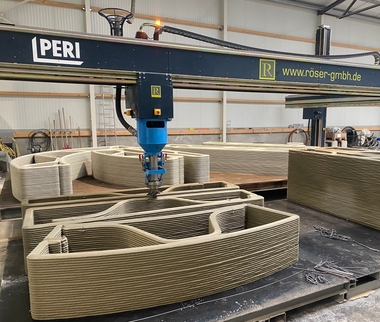
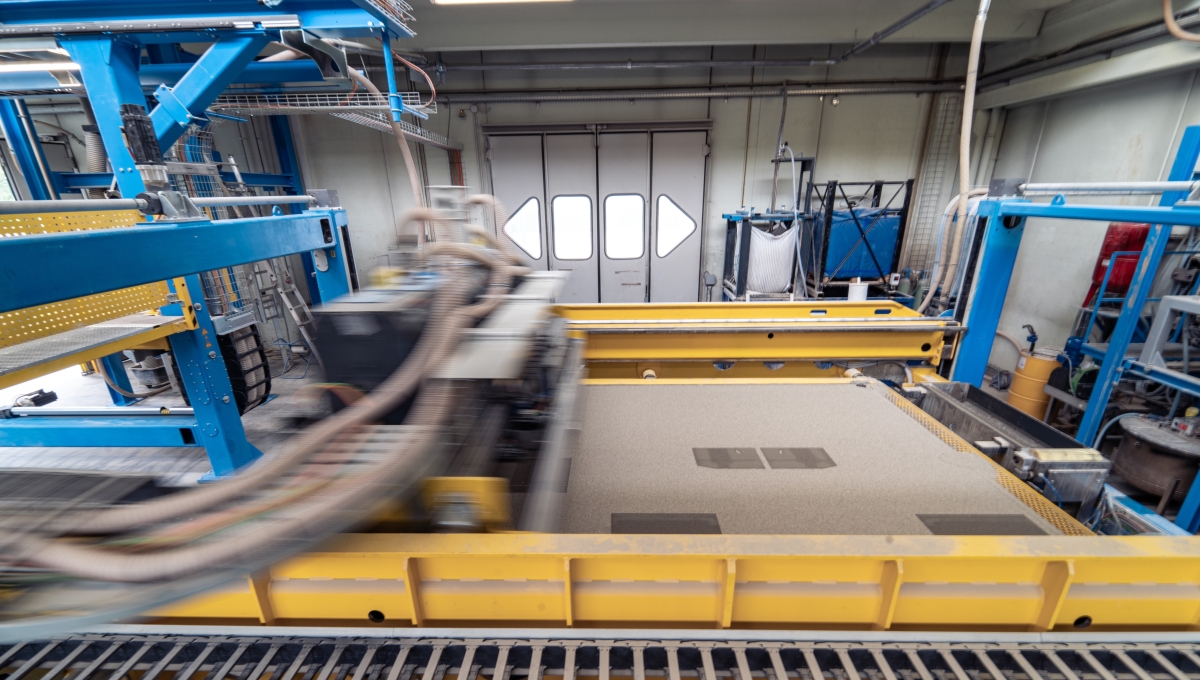
Mangrove is a concrete additive manufacturing company focused on large scale freeform architectural, landscape, and site components that are difficult or uneconomical to produce with conventional tooling. The company is the first in the world to bring Selective Paste Intrusion (SPI) concrete printing, created by Progress Group 3D Concrete Printing, into a purpose-built production environment designed for repeatable, scalable output. SPI works like a powder-bed system. A thin layer of fine aggregate is spread across the area. A print head then selectively injects cementitious paste into the aggregate bed at the locations defined by the digital model. The paste fills the voids around the aggregate, binding it into a solid concrete structure at the cross-section. The remaining, unprinted aggregate stays loose and acts as self-supporting, holding the geometry in place as the build progresses.
This approach delivers two critical advantages for architectural concrete:
First, the surrounding aggregate supports the part during printing, and second SPI achieves fine surface resolution. Traditional mold-based production requires draft - slight tapers that allow a part to be released from the form. Negative draft geometry, where the shape hooks or widens in the direction of release, forces molds to become multi-piece assemblies with inserts and split lines. Each added piece increases cost, labor, and risk. SPI eliminates this constraint entirely.
From printing to production-ready components
Printed elements can be delivered with a range of finishes, from the natural fine texture of the printed surface to additional architectural treatments that meet project specifications. Connection points, tolerances, and installation interfaces are defined early, ensuring that printed components integrate seamlessly into conventional construction workflows. This is where the Kerkstra Family experience becomes critical. Printed elements are not treated as novelty objects, but as engineered concrete components - designed, handled, and installed with the same rigor as traditional precast. With SPI, complexity shifts from physical tooling to digital preparation and controlled production. Once a design is validated, geometry can change without rebuilding molds. Variation becomes a manageable design decision rather than a tooling crisis.
3D printing is the next chapter for architectural concrete
As architectural concrete becomes more expressive and customized, the true cost is increasingly hidden in formwork. By combining Mangrove’s SPI printer with Kerkstra Precast’s multi-generational expertise, the industry gains a powerful new option - one that respects the discipline of precast manufacturing while unlocking new geometric freedom.
CONTACT
Mangrove
5265 68th St SE
Caledonia, MI 49316/USA
+1 616-271-6800
Progress Group
3D Concrete Printing
Schrambach 34
39040 Feldthurns/Italy
+39 0472 979 100