

Holcim White

Unusual bridges along the A 72 superhighway
The German superhighway A 72 can look back on a long history. Its construction began in the 1930s to provide a corner connection for the north-south route from Berlin to Munich and for the east-west route from Dresden to Bad Hersfeld. Its purpose was to link up Silesia and East Saxony with Bavaria. But World War II and the division of Germany put a stop to its completion. Construction work on the route between Chemnitz and Leipzig was resumed only following unification of Germany in 1990.

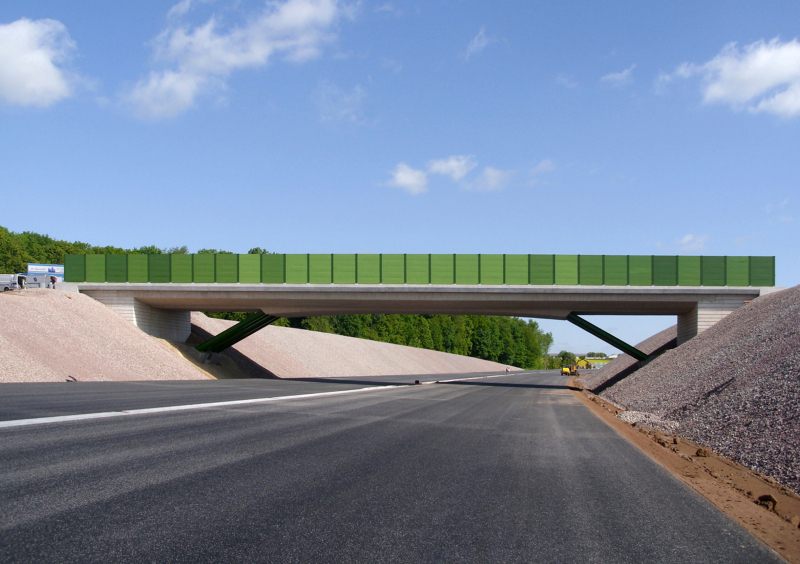
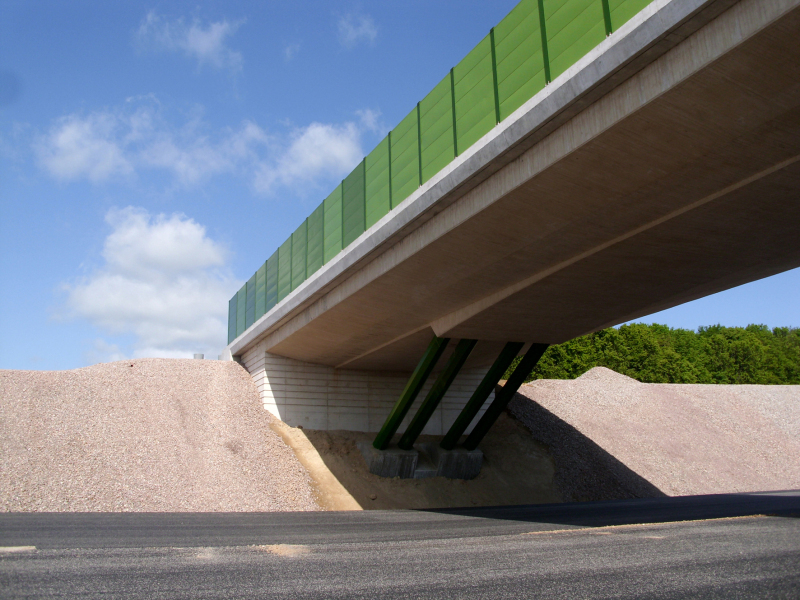
As part of this extension, many different bridges were constructed and are still being built, quite a number of which are interesting. Two of them are unusual: not because of an excellent, sophisticated supporting structure – both cases involve framework constructions with diagonal frame supports. They are also not critical for routing superhighway traffic. Both are located on the section between Rathendorf and Frohburg and primarily serve agricultural traffic. Both bridges are extraordinary because a special building material was used for their construction: concrete made of white cement. White cement belongs to the group of Portland cements and is manufactured by a complex process.

White cement,
colored concrete

Both construction sites were supplied by the concrete plant Betonwerk Bad Lausick, which has worked with white cement from Holcim for years. “In addition to ready-mixed concrete, we also manufacture products for road and path construction, as well as other fair-faced precast concrete products,” says Frank Obuch, manager of the concrete plant. “Some of the precast products are colored with pigments. We have been using white cement from Holcim with very good success for years for these products.”

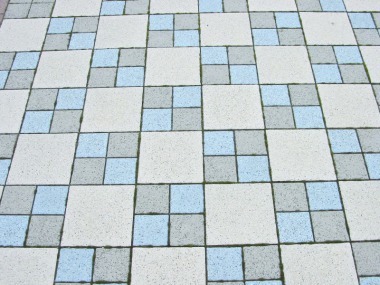
The high-quality binder can, indeed, not only be used for creating brilliant white concrete surfaces: it is also superbly suited for colored concrete. The reason for this is that concrete surfaces made from white cement will appear more brilliant than their gray counterparts.

But white cement scores not only in terms of appearance. Its technical properties easily match those of its gray counterparts: the same strength classes can be achieved and there is also no difference when used together with admixtures or similar products.

Fair-faced concrete grade IV

Holcim produces its white cement in the Slovakian city of Rohoznik and markets it under the name of Holcim White in 17 European countries. The company places great importance on products of superior quality and on good consultancy. Holcim staff members also frequently serve as highly competent contact partners in decisions on a specific release agent or formwork.

Because fair-faced concrete grade IV was specified for both of the above-mentioned bridges, the contractor’s staff at Sächsische Bau GmbH in Dresden, Germany, decided on the use of plastic-coated shuttering panels, which were used only once for this construction project.

Narrow window of time

“The greatest challenge for this project was to achieve uniform coloring of the concrete – which was a question of logistics. To prevent streaks, each of the almost 600 m³ batches of concrete had to be of the same consistency and had to be delivered to construction site within a specified window of time,” said Norbert Leh, the contractor’s General Site Manager.

The good collaboration among the companies invol­ved in the construction of the bridge can be readily seen at the A 72 superhighway. Today, both structures shine in light color and, with their green visibility protection elements, harmoniously blend with their surroundings. Holcim white cement (slow) CEM I 52,5N was used for both projects.

Text: Dipl.-Ing. Claudia El Ahwany
x

Related articles:

Issue 07/2017

Reasons for color variations in colored concrete

Frequently, the requirements on colored architectural concrete are very high. The appearance of the same is again and again compared with the uniformity of a metal surface painted in serial production...

more
Issue 07/2018

Coloring concrete – which factors are important

The coloring of concrete has ceased to be a novelty for a long time now. And although new insights are continuously being gained in this area, the danger of undesirable color deviations is...

more
Issue 04/2012

Concrete coloring: Basic principles leading to optimal results

One of the important components of designing our living environment is the use of colored building materials. Although their manufacture differs only marginally from the production of non-colored...

more
Issue 07/2014 Holcim

Colored from wall to floor

The Budapest Bisztró – a restaurant established in 2012 in an existing building in the heart of the Hungarian capital – captures the attention of its guests with its attractive interior design. The...

more
Issue 04/2010 Evironmentally Materials

Photocatalytic Concrete in Color

Products made of photocatalytic concrete are mainly achieved by cements that are doped with photocatalytic titanium dioxide, therefore only white and grey products are commonly available. There is...

more