

Compressive strength of lightweight concrete masonry

Defining fk values in the national annexes to EC6

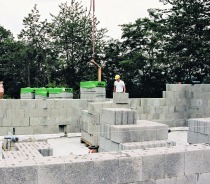
One of the main objectives in revising DIN 1053-1 was a more differentiated description of the compressive strength of masonry as a function of the different types of blocks used in order to be able to better utilize structural capacity reserves in the future. In addition, a formal approximation to EC6 was to be achieved together with an update taking into account newfindings. The calculation model according to EC6 including a power function and parameters depending on the block-mortar combination was used in the process to enable a subsequent translation for the national annexes to EC6....

Related articles:

Issue 02/2014 Simplified calculation method

The new EC6 European masonry code –

Compared to the DIN 1053-1:1996 and DIN 1053-100:2007 masonry standards, DIN EN 1996-3:2010 [1] contains significant improvements and simplifications in conjunction with the National Annex [2]...

more
Issue 11/2016 KLB Klimaleichtblock

Eurocode 6 brochure provides design tables

The equivalence of Eurocode 5 and DIN 1053-1 ended at the beginning of 2016. DIN EN 1996/NA became the only standard that governs structural verifications. In response to this development, KLB...

more
Issue 02/2020 Building safety

Burglar resistance using masonry and walls made of lightweight concrete

The product range of lightweight-concrete and concrete block masonry includes both heavy, high-strength blocks for interior walls, party walls, and double-skinned, additionally insulated (ETICS)...

more
Issue 02/2014 Day 2: Mittwoch, 19th February 2014

Lightweight concrete

120 DIN 4213 – The German application standard for prefabricated components of  lightweight aggregate concrete with open structure DIN 4213 – Die deutsche Anwendungsnorm für vorgefertigte...

more
Issue 07/2024

Lightweight granular materials made from mixed masonry rubble for use in infra-lightweight concrete

Introduction Infra-lightweight concrete exhibits an extremely low dry bulk density of up to 800 kg/m³ while also providing sufficient strength, resulting in low thermal and acoustic conductivity....

more