

Benefits of Adhesive Technology at the “Schleifmühlchen” Traffic Junction


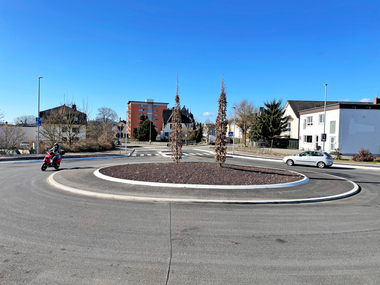
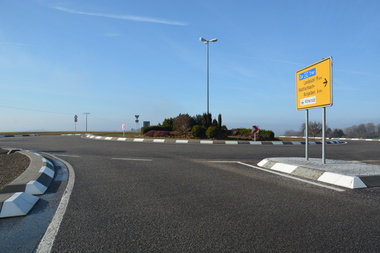
In the university town of Siegen, the “Schleifmühlchen” junction serves as a major distribution point for surrounding inner-city junctions and adjacent urban areas. As early as 2002, the city of Siegen established a temporary traffic layout in the form of a roundabout at the junction during the reconstruction of Fludersbach road. This temporary solution remained in place for more than 20 years and was completely rebuilt in mid-2025 as a two-lane roundabout with two bypasses, compliant with applicable design guidelines, in order to improve traffic safety and traffic flow. The curb bonding technique from concrete product manufacturer Hermann Meudt of Wallmerod was used for the perimeter curbs.
Comprehensive Expansion of the Traffic Infrastructure
Due to its importance within the road network, the “Schleifmühlchen” junction is subject to a high average daily traffic volume. The aim of the road reconstruction was to better accommodate the needs of pedestrians, cyclists, public transport and motorized private transport. This required a comprehensive expansion of the traffic infrastructure.
As part of the project, a section of the southern retaining wall along the “Weiß” watercourse was also renewed. For this purpose, an overlapping bored-pile wall with a cantilever slab was constructed to support the sidewalk. The construction work also included the reconstruction of the approach arms leading into the roundabout over varying lengths of up to 145 m.
The road reconstruction was carried out largely within the boundaries of the existing road infrastructure. Only in the area of Marienborner Straße were the traffic areas widened. The elevation design, particularly for the approach arms, was based on the existing road levels. In the area of the new roundabout, the traffic areas were constructed up to 1.30 m higher than the previous road level.
Faster Installation – Fewer Traffic Disruptions
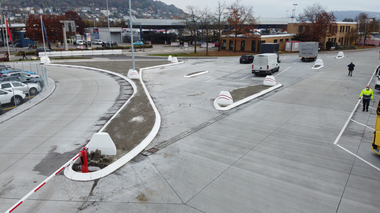
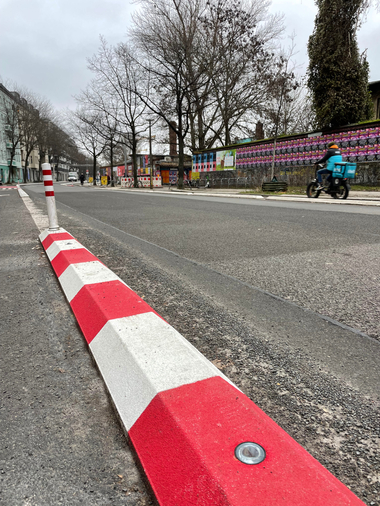
A distinctive feature of the project is the use of special elements for edging the roundabout, traffic islands and crossing areas. These were primarily installed using the curb bonding technique from Hermann Meudt. In this process, the curbstones are not conventionally set in concrete but bonded directly to the asphalt binder
course.
Jan Witowski, managing director of PlusPlan Ingenieure GmbH in Siegen, explains the reasons: “The bonding technique allows for continuous construction of the asphalt pavement. This avoids joints and increases the durability of the frost-resistant pavement structure. Furthermore, because there are no embedded elements, the curb bonding technique significantly increases the installation rate of the asphalt pavement.”
Due to the high traffic volume, the project area had to be divided into numerous construction phases to maintain traffic flow during construction. The bonding technique allowed the future traffic islands and green spaces to be used initially for temporary traffic routing. According to the planner, another advantage was the elimination of the curing times associated with conventional concrete foundations. “Because the bonding technique does not require the curing times of concrete to be taken into account, as is the case with conventional concrete foundations, the construction period could also be significantly shortened,” says Witowski.
Thin-bed Bonding Method for the Curbstones
The curbstones are bonded using a thin-bed adhesive method. The curbstones with a 30 × 25 cm profile are cut at the factory to a height of 20 cm and then bonded on the cut surface. This compensates for manufacturing-related variations in height and calibrates the units for bonding. The cutting process also removes the cement skin, which, according to the manufacturer, improves the adhesion of the adhesive.
Various radii and shaped units were available for the traffic islands and roadway edging. This reduced the amount of cutting required on site.
On September 22, 2025, the “Schleifmühlchen” junction was officially opened to traffic. According to the project participants, the reconstruction has since resulted in smoother traffic flow.
CONTACT
Hermann Meudt Betonsteinwerk GmbH
Frankfurter Straße 38
56414 Wallmerod/Germany
+49 6435 5092-0