

Report from practice on the X-Seed 100® accelerator from BASF
TBA Trimmiser Baustoffe AG is an independently-managed company and is known for the high-quality concrete components it manufactures to customer’s requirements for all possible applications in the areas of building construction, underground, tunnel and hydraulic structures. In the manufacture of precast components in fair-faced concrete quality, the company uses X-Seed 100® with great success.
X-Seed 100 was introduced to the public by BASF Technology Center in Trostberg/Germany in the autumn of last year (BFT 01/10). The protected technology is based on seeding (injection) of the pore solution with synthetically manufactured calcium-silicate-hydrate crystallites, which are made available to the customers as liquid admixtures for addition into the concrete mix in the mixer in the usual manner. Since no nucleus formation energy is needed for the seed crystals, in contrast to common cement hydration, and because the existing nanoscaled crystallites can grow simply in the oversaturated pore solution, the cement paste is able to set markedly faster. This effect has been observed both in cold and warm temperatures and even when the concrete is heated – a special feature, since the classic hardening accelerator is typically effective only in low temperatures.
The team
The Trimmiser team demonstrated its motivation and interest in the latest state of technology also during the latest test series for validating the new BASF hardening accelerator X-Seed 100 in self-compacting concrete (SCC). The Trimmisers had no previous information about the new product to ensure an unprejudiced assessment of the aimed for qualitative effect of in the manufacturing process. As reference product, angular elements for slope stabilization in fair-faced-concrete quality were selected.
The test
The objective of the test was to increase productivity, at the same quality level or better. Concrete elements are typically demolded upon reaching a compressive concrete strength of 15-20 MPa. To monitor the evolution of heat induced by the hydration of the cement, a heat sensor was placed at equivalent positions in the freshly cast concrete of the three specimens.
At first, the reference SCC (C 30/37 XD3 XF2 Cl 0.10 Dmax=16 F6) was manufactured in a modern, computer-controlled pan mixer without the addition of admixtures and, following mixing over the specified period, emptied into a concrete bucket, from which sufficient concrete was taken for the fresh- and hardened-concrete test that was immediately carried out. The new BASF hardening accelerator X-Seed 100 was dosed after adding all other constituents of the mix.
The concrete was transported by crane into the prepared form and cast immediately. The workability of the concrete was excellent during the entire production pro-cess. The exposed surface was covered with a thin film to protect it from drying out.
Supervision and testing were carried out by the accredited testing laboratory Griso Prüflabor AG. Twelve cube-shaped PVC forms were filled with concrete from each mix and covered with film and subsequently placed in the damp room (>95% r.h.) of the lab under controlled conditions up to the time of testing.
The result
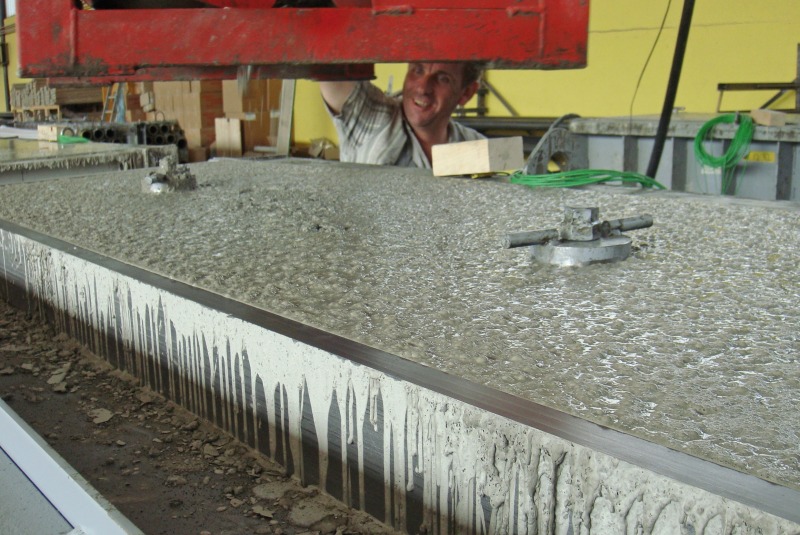
The test specimens were demolded at late as on the following day without noticeable problems (Fig. 1); the low-porosity, first-class fair-faced concrete quality was reached in every case. The significant much more rapid hardening process in the early hours of cement hydration is characteristic for the effect of X-Seed 100. In theory, the elements could be demolded as early as after 4 hours, thanks to the acceleration, considering that – experience has shown – the strength in an element is higher than the strength measured in the cube. Accordingly, a doubling of the production cycle would be possible under the same operating conditions.


Fig. 1 Clearly visible: the conductor of the...