

Reinforcement systems for subsequently connected reinforced-concrete brackets
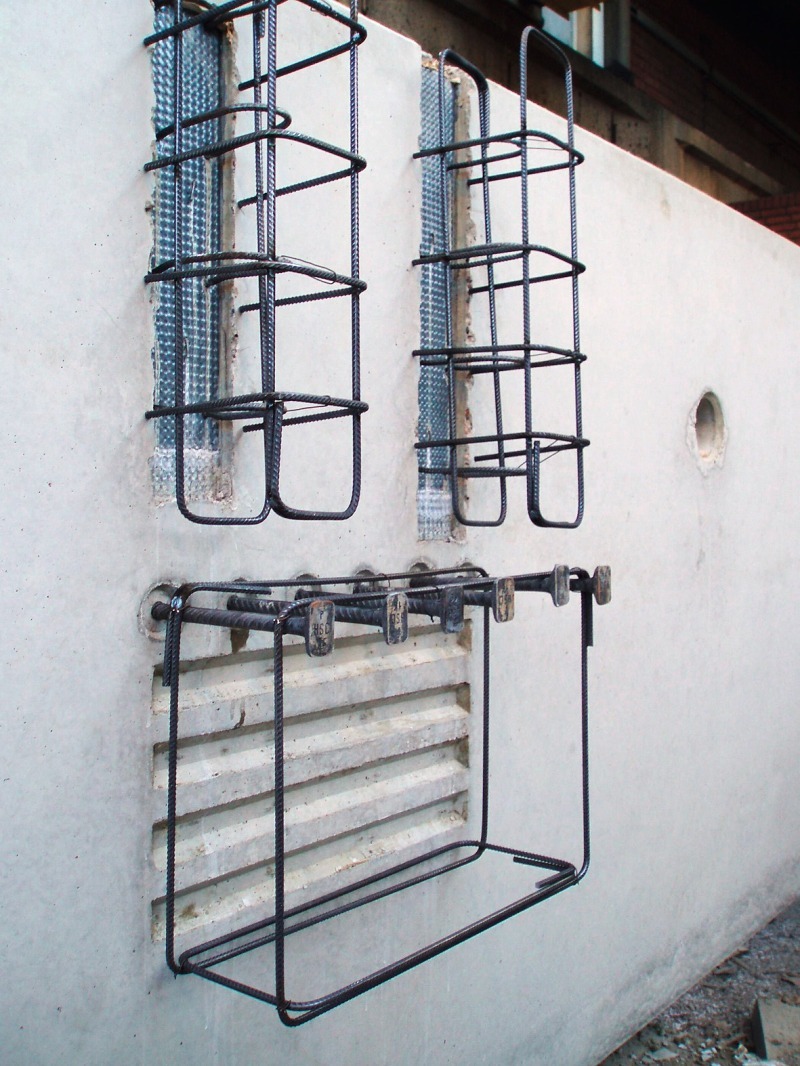
In particular in precast concrete construction there is a significant need for connecting reinforced-concrete brackets to a wall or a column in a second step of concrete placement. This kind of construction saves elaborate formwork and entails advantages in terms of time. In many cases, a subsequent connection has not even been considered in the planning phase. When planning, it is normally proceeded on the assumption of a monolithic connection.
What solutions are available?
As a solution, Halfen company provides two different versions for a subsequent connection. One option is the Halfen HBT Rebend Connection type 7.
The closed casing is nailed onto the formwork and after dismantling the formwork of the first casting step the stirrups are bended out of the case. Afterwards the bracket is concreted.
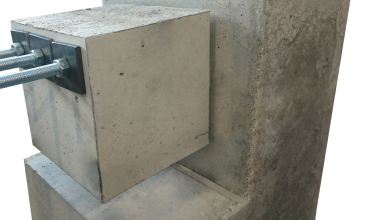
Another version is to realize the bracket in a second concreting process, which is provided by the screw connection Halfen HSC Stud Connection (Fig. 1). Owing to sleeve and threaded rods it is possible to place concrete in two steps.
Each of the two systems provides different advantages depending on the bracket type. Therefore, the following part shall briefly point out special requirements concerning the bracket design having an impact on the selection of a suitable construction product.
General remarks about the bracket design
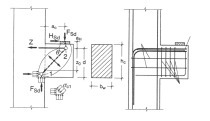
A bracket is concerned if the boundary conditions expressed by the ratio of distance from the column section to the load application point ac to a bracket height hc have been fulfilled.
As long as the condition 0.2 ≤ ac/hc ≤ 1.0 is kept, the planned building component may be considered as being a bracket.
In case of 0.2 ≤ ac/hc ≤ 0.5 it is a short bracket and in case of 1.0 ≥ ac/hc > 0.5 it is a long bracket. It is necessary to make a difference here, because a horizontal alignment of the splitting tensile reinforcement has proved to be more favorable in case of short brackets, whereas in case of long brackets a vertical alignment of the stirrups is favorable.
Furthermore, a sufficient degree of anchoring in the column and/or the wall as well as in the bracket itself has to be made sure.
Construction by means of Halfen HBT Rebend Connection
Halfen HBT Rebend Connection makes a subsequent connection especially in case of line brackets with just minor cantilever lengths possible.
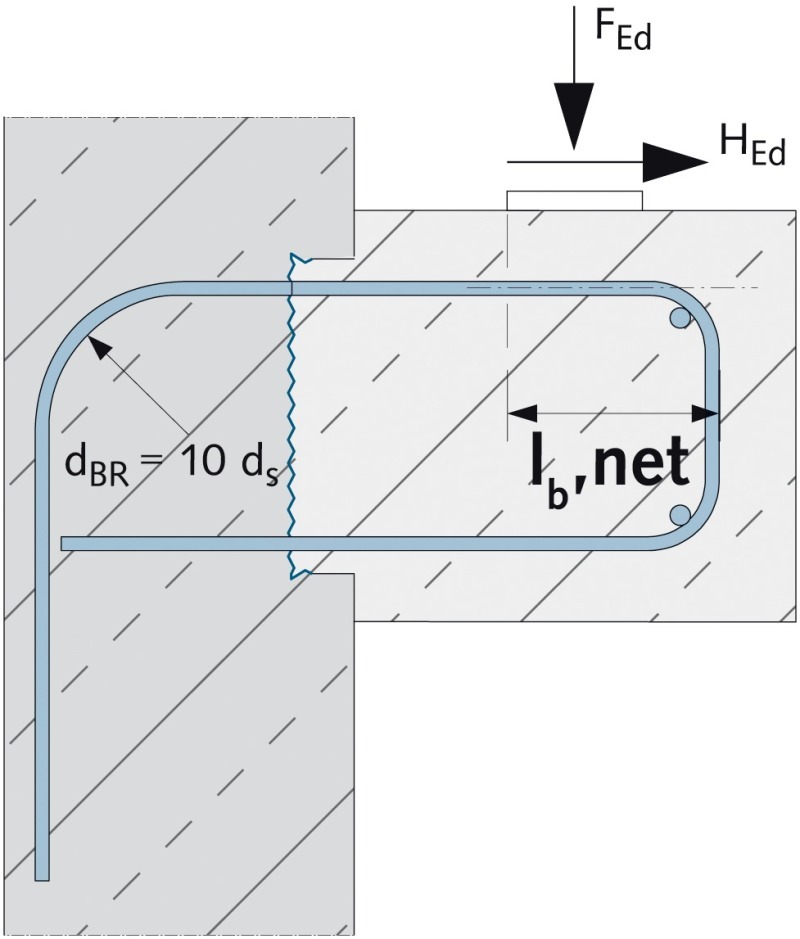
Since the actual anchorage length is defined as shown in Fig. 2, often just a short anchoring length will be achieved within the bracket and the cross-section of the reinforcement has to be increased.
For determining the required length of overlap it has to be taken into account, that when using rebend connections the bearing strength of the steel may only be utilized by 80% owing to the reverse bending process. Because of this reason, it is absolutely necessary to conduct a statical test in case of subsequent connections.
Consequently, a general assumption about the fact that the cross-section of the reinforcement calculated for the monolithic building component is also sufficient for a building component with subsequent connection does not apply at all!
As the utilization of steel is limited and as the cross-section of steel for rebend connections is restricted to up to 12 mm inclusively, the transferable forces are limited.
Construction by means of Halfen HSC Stud Connector
The Halfen HSC Stud Connector makes it possible to realize brackets bearing higher loads subsequently. This screw connection with national technical approval has an upset anchor head achieving complete anchoring in the bracket as well as in the column and/or wall area. For achieving the anchorage in the bracket by means of Halfen HSC Stud Connector there has to be a clearance between the end of the supporting plate and the anchor head as defined in the approval. An elaborate and fault-prone reinforcement design is avoided in this way.
Owing to the design of the product for heavily loaded brackets, the manufacturer offers bars with a diameter of 16 mm, 20 mm and 25 mm for the system Halfen HSC Stud Connectors. As to be able to ensure prompt delivery, there are now also defined standard lengths for the bar diameters of 16 mm and 20 mm.
Conclusion
For the construction of reinforced concrete brackets in a second step of concrete placement Halfen provides both HBT Rebend Connections for line brackets and the HSC Stud Connector for heavily loaded single and line brackets. These systems are suitable for precast concrete construction as well as for the application at an in-situ concrete construction site.
For the required verifications when using the HSC Stud Connectors a program based on Excel is available for free download on the homepage at www.halfen.de.
For getting a dimensioning guidance for the Halfen HBT Rebend Connection there is the possibility to apply to the International Competence Center Technology (ICT) sending details about the geometric boundary conditions and loads. ˘


Fig. 1 The screw connection Stud Connection.
Fig. 2 The anchorage length of the bracket.